
Why Knowing Your Attachment Style Hasn’t Changed Anything 🧠
You can diagnose yourself in your sleep. So why are you still doing the same thing? (10min read)

TL;DR Summary:
You can name every one of your patterns perfectly — and still repeat them on a loop. Here’s the part nobody tells you about why.
Understanding why you do something and actually changing it run on two completely different systems. Most people only ever work one of them.
Your attachment wound doesn’t live in your thoughts. So no amount of thinking has been able to reach it.
Talking about a wound before your body feels safe can quietly make it louder. You may have been doing this for years.
There’s an order of operations to healing — and “doing the work” without it is like renovating a house from the attic while the foundation cracks.
You’re not failing. You’ve been doing the right work in the wrong sequence. Let’s fix the sequence.
Insight Is NOT Healing
You know you’re anxiously attached.
You could give a TED talk on it. You’ve read Attached. You’ve read The Body Keeps the Score.
You’ve done therapy, shoot, maybe even years of it.
You can trace your patterns back to your childhood with the precision of a forensic investigator. You can clock another person’s attachment style before the appetizers arrive.
And yet…
You’re still spiraling when he takes four hours to text back. You’re still over-functioning to earn a love that should be freely given. You’re still, somehow, in the exact same dynamic with a slightly different face.

So here’s the question you gotta ask yourself: if understanding your patterns was enough to change them, wouldn’t you be free by now?
You’re not broken. You’re not “self-sabotaging.” And you’re definitely not lazy.
High-achieving women are the last people on earth who can be accused of not trying hard enough.
You’ve just been sold a quiet lie. The lie that insight equals healing.
It doesn’t.
And today I want to show you, through the actual neuroscience, why understanding your wound and healing your wound are two different jobs, run by two different systems.
Once you see this, the last few years of “doing the work” will finally make sense.
Let’s dive in!
Where Does Your Attachment Wound Even Live?
First of all, an attachment wound is a kind of trauma.
Not always the dramatic, capital-T kind, often it’s the slow, quiet kind.
A parent who loved you but couldn’t attune to you. A caregiver whose moods you had to monitor. Affection that came and went on a schedule you couldn’t predict.

Most people don’t understand that trauma is not defined by the event.
It’s defined by the experience.
Think of a house fire. The same fire that traumatizes the homeowner who watches their life turn to ash doesn’t traumatize the firefighter walking directly into the fire on purpose.
Same event. Completely different nervous systems, roles, and reference points.
In other words, a completely different effect.
This is why your sibling can shrug off the exact childhood that wounded you.
You weren’t “too sensitive.” You experienced it differently, and your nervous system organized itself around what you lived through.

And a lot of this organizing happened before you had words.
Your attachment template was largely laid down in your first few years of life, preverbal, pre-memory, pre-story.
It got encoded in your body and your nervous system long before the thinking, talking part of your brain came fully online.
Read that again.
This means the wound was probably installed before language.
So when you sit down years later and try to talk your way out of it… You’re using a tool that can’t reach the place where the wound is stored.
That’s not a you-problem. That’s an architecture problem.
Yes, dear friends, that does mean we’re about to dive deep into some neuroscience.
Buckle up!
Top-Down vs. Bottom-Up: How Your Brain Actually Works
If you’ve been on the relationship/mental health side of social media in the last few years, you’ve probably heard the terms “Top-Down” and “Bottom-Up.”
Unfortunately, it’s usually two people who think one is better than the other for healing, yelling at one another…
But before we debate this, where do these terms even come from?
Between your ears, baby.
They’re actually neuroscience terms, specifically the two directions your brain processes information.
Top-down processing means using knowledge already in your head to shape what you perceive.
The easiest way to understand this is a demonstration. Look at the picture below.
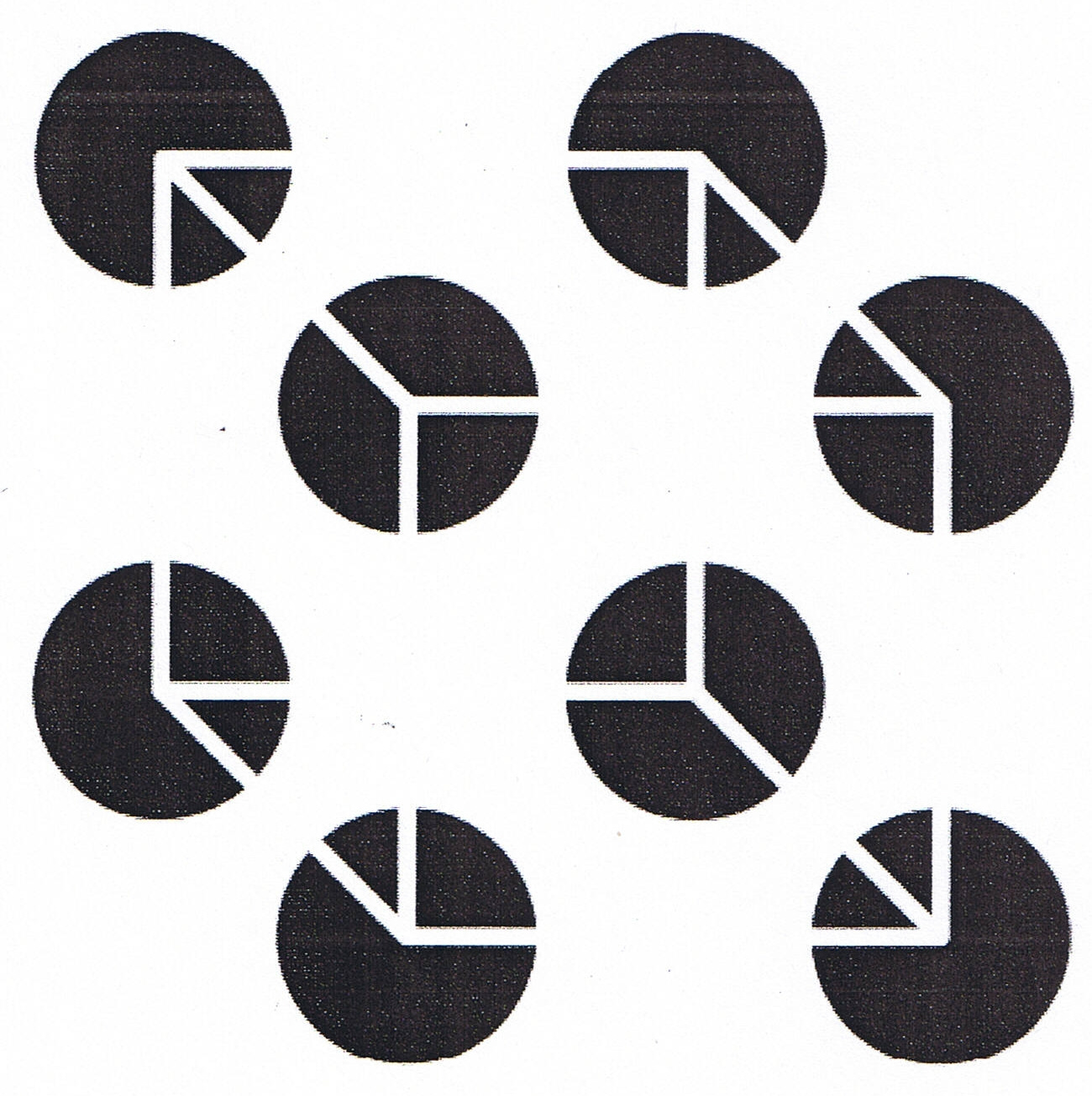
What shape do you see? Can you see the cube?
This is really a picture of black circles with lines in them, not a cube, but it’s almost impossible to not see the cube, why?
Top-Down processing! You have background knowledge & reference frames for a cube in your mind already, so your brain creates the cube inside the image with this knowledge.
Bottom-up processing is the opposite.
Here’s another demo. Look at the picture below.

Unless you happen to be an airline pilot, when you look at this picture, you have to analyze all its parts with your senses.
As you do this, you start to build a construct in your mind about its different parts & what they might do.
So, Bottom-Up means going from the senses your body collects up to your brain!
Sensation first, then meaning.
You need both. Neither is “better.”
BUT they are not interchangeable when it comes to healing.
Let’s talk about why not.
What’s This Got to Do With Healing?
Great question, dear reader.
When thinking about this in relation to therapy & healing the mind, brain & body, I find the picture below to be helpful!
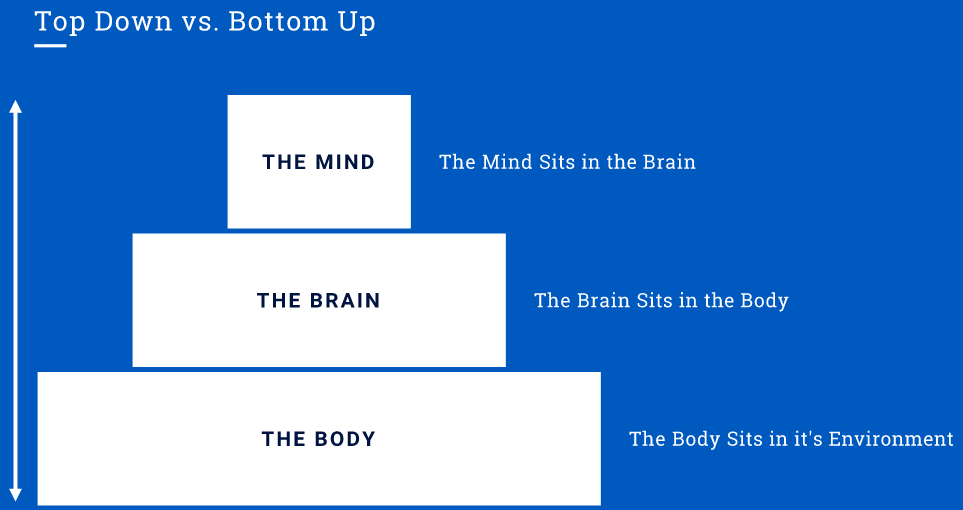
These 3 parts of us are separate but inseparable, and each affects the other.
Each one is the soil for the next.
The body is where emotion is generated, stored, and felt.
The brain is the wiring connecting everything.
The mind is the voice in your head. Your thoughts. Your stories. Your insight.
The body holds the brain. The brain holds the mind. Which means the body is the soil for the brain, and the brain is the soil for the mind.
It’s a little oversimplified, without a doubt, but it’s the most useful map you’ll get for what we’re about to do.
Using this map, you can now think of therapeutic modalities in two ways, you guessed it, Top-Down & Bottom-Up.
Top-down approaches work with the mind.
They help you talk through, reframe, and reprocess your thoughts, memories, and beliefs.
Think CBT, DBT, cognitive processing therapy, most talk therapy, and, let’s be honest, every self-help book, podcast, and Instagram carousel you’ve ever consumed.
Bottom-up approaches work with the body first.
They settle the nervous system, “fertilizing the soil,” so the brain can actually heal, which then heals the mind, because now your thoughts are growing in healthier ground.
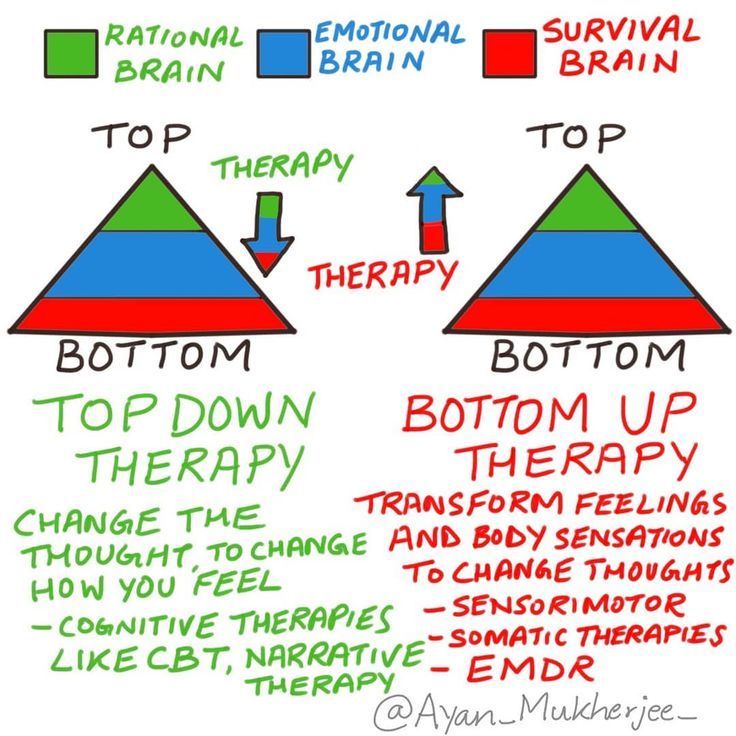
And here’s the part you don’t want to hear…
You have likely been doing mostly top-down work on a bottom-up wound.
You’ve been renovating the attic while the foundation is cracked.
No wonder it never holds.
Why Insight Can Backfire
For decades, clinicians & scientists genuinely believed you could think your way out of a trauma response.
Talk about it enough, understand it enough, and you’ll be free. It’s why the earliest trauma treatments were almost all top-down.
Then, in the late ‘90s and early 2000s, neuroimaging got good, realllll good. And the picture that came back was sobering.
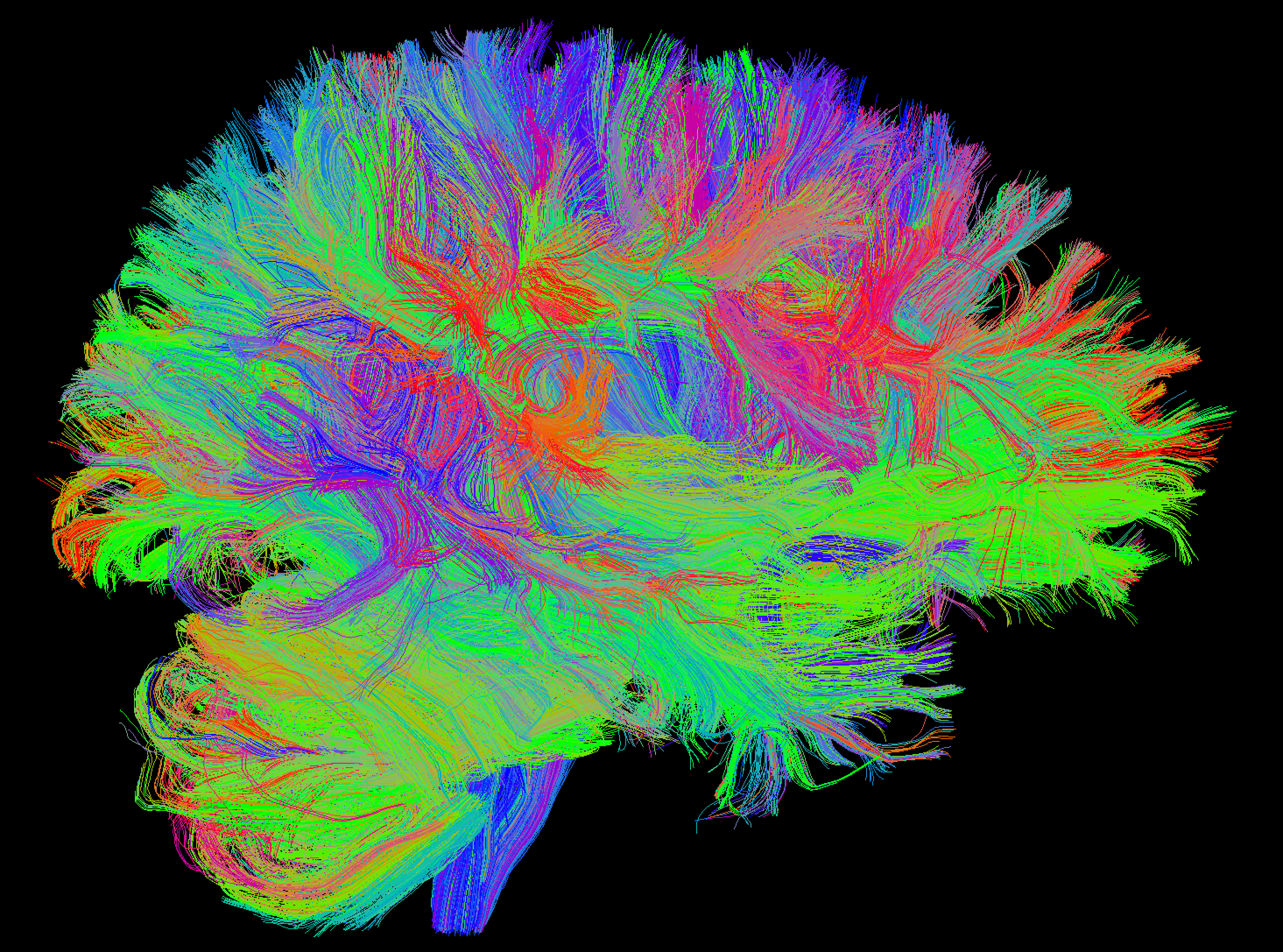
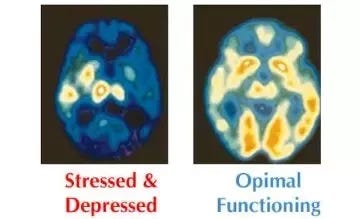
Research began to suggest that simply recalling and talking about trauma, without the body feeling safe first, tends to do three things:
Spikes the amygdala, the brain’s threat alarm.
Quiets the prefrontal cortex, the calm, thinking, perspective-taking part of you.
Can intensify symptoms, anxiety, shutdown, that hollow dread.
Let’s sit with that for a second…
This essentially means that talking about your wound, when you’re not regulated, can hand the microphone to the alarm and mute the adult.
It gets worse.
The hippocampus, your brain’s librarian, the part that files memories into a coherent story, partially goes offline during overwhelming experiences.
So the memory never got filed properly in the first place.
It’s stored instead in implicit memory: emotional memory, body memory, and sensory memory.
That’s why a song, a smell, or a certain tone of voice can drop you straight into a feeling you can’t explain.
The wound isn’t in a filing cabinet you can search with words. It’s in the walls.
This is the reason your insight never reached the wound.
You were searching the wrong floor of the building, dude.
One more bit of research I find relevant to this conversation!
Your vagus nerve is a highway connecting your body and your brain; it’s like the superhighway of your nervous system.
And the traffic on it is not balanced.
Roughly 80% of its fibers carry signal up, body to brain. Only about 20% carry signal down, brain to body.
On one of your nervous system’s biggest information highways, the body is doing most of the talking.
The brain is mostly listening.

So when your strategy is “think better thoughts to feel better,” you’re not wrong to try, that 20% is real.
But you’re sending instructions down a lane that’s four times narrower than the one your body is shouting up through.
Sometimes it works. Mostly, it just exhausts you.
That’s not a confidence problem.
That’s a nervous system doing exactly what it was built to do.
Ok, Cody, so what do I do about this?!
So glad you asked!
Exactly What to Do About It
Ight, let’s get practical now.
And here’s the good news: you don’t have to throw away a single thing you’ve learned.
All that insight isn’t wasted. It’s just been waiting for a foundation to stand on.
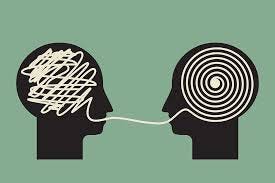
You don’t need more understanding. You need a different order of operations.
Here’s a 3-step sequence, bottom-up first, top-down second.
Step 1: Settle the Body Before You Touch the Story
The rule: regulation before reprocessing. Always.
Before you analyze the spiral, the text, and the dynamic, get your nervous system back inside its window of tolerance.
Slow exhales (longer out-breath than in-breath). Feet on the floor. Hand on your chest. Orient to the room, actually look around, and let your body register that you are, right now, safe.
This isn’t a “calm down” cliché. You are physically bringing the prefrontal cortex back online so it can do its job.
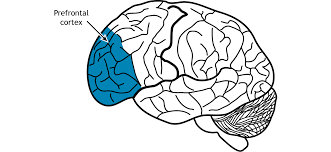
You cannot reframe a thought with a brain that’s stuck in threat. Settle first. Think second.
Step 2: Build Interoception
Interoception is your ability to sense what’s happening inside your body. It’s the muscle that’s been underused while you lived in your head.
Practice, daily, when nothing is wrong: “Where do I feel this in my body right now? What’s the actual sensation — tight, buzzy, heavy, hollow?”
Name the sensation, not the story.
These are small reps. They’re boring. They’re unsexy. And they are how you build the bottom-up channel that lets real change travel.
Step 3: Bring Insight In & Let the Story Update
This is where your top-down work finally pays off.
Once the body is settled and you can feel yourself, revisit the old belief, “I’m too much,” “love isn’t safe,” “I have to earn it,” while staying regulated.
Hold the old story and a new, true experience at the same time: I am safe right now. I am an adult. I have choices my younger self never had.

When an old emotional memory gets reactivated gently, alongside a contradicting experience, the brain can actually rewrite it, not just bury it under a better argument.
That’s the difference between insight that decorates the wound and insight that closes it.
Why I Won’t Shut Up About IFS
If you’ve been around here for more than a minute, you saw this coming. You know I’m obsessed with IFS.
Now you know why.
For years, I understood how important this sequence of bottom-up, then top-down, was, but I had to basically duct-tape modalities together to achieve this.
Then I learned about Internal Family Systems, and something clicked that I haven’t been able to un-see since.
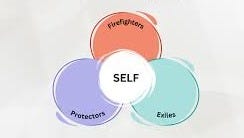
IFS isn’t another modality. It’s really an operating system.
Every other approach tends to live on one floor.
Talk therapy works on the mind. Somatic work works the body.
They’re both good. But IFS holds the whole building at once:
It goes bottom-up by finding the part in your body. A felt sense. A tightness, a buzz, a heaviness. You don’t analyze it, you sense it. That’s somatic. That’s regulation.
Then it goes top-down as you get curious about that part’s story. What it believes. What it’s afraid would happen if it stopped. Then you update it with new information from your adult Self.
That’s meaning-making. That’s the narrative work.
And the thing that holds it all together is the Self, that calm, curious, compassionate presence underneath all your parts.
Self-energy is a regulated nervous system. And Self is also the one wise enough to witness the wound and reparent it.
Mapping Your Inner World
The IFS model even sorts your patterns and protective mechanisms into top-down and bottom-up groupings.
Your Managers, the anxious planning, the over-functioning, the controlling, those are top-down protectors.
Your Firefighters, the spiral, the impulse, the 2am text, those are bottom-up reactors.
And underneath both, your Exiles, the young, wounded parts holding the original pain that everyone else is working overtime to keep you from feeling.
You’re not a mess. You’re a system.

Beautifully organized around an old wound, with a Self at the center that was never actually damaged, just crowded out.
That’s not a technique. That’s a way of being.
So, if you want something that blends all of this instead of duct-taping it together, this is where I’d point you.
Where This Leaves You
You were never failing at the work.
You were doing the right work in the wrong order, leading with the mind when the body needed to go first.
Insight was never going to be the thing that healed you. But it was never useless either. It’s the map. The body work is the territory.
On the other side of this, the spiral loses its grip.
The panic gets quieter. And the love that’s actually good for you stops feeling boring or suspicious, and starts feeling like something your nervous system can finally receive.
You’ve got this.
And as always, until next time… Live Heroically 🧠
Want to Work With Me? Here Are a Few Ways I Can Help You
Becoming HER is a 63-Day program that heals heartbreak & prepares you for modern dating, using Neuroscience & Internal Family Systems. (If you’re seeing this, one of our cohorts is open currently!)
Going through a breakup? Check out She Rises. It’s a post-breakup protocol based on neuroscience to help you regulate your nervous system in the days and weeks right after a breakup.
Grab my new ebook: Exactly How to Become Emotionally Available: It’s a step-by-step guide for attracting and keeping the love you seek, built for the success but single among us!
Become a paid subscriber to the Mind, Brain, Body Lab Digest: You’ll get subscriber-only posts, email replies, access to my entire blog archive, early access to new products, workshops & tools I create!
Supporting Research
Felitti, V. J., et al. (1998). Relationship of childhood abuse and household dysfunction to many of the leading causes of death in adults: The Adverse Childhood Experiences (ACE) Study. American Journal of Preventive Medicine, 14(4), 245–258.
Schore, A. N. (2003). Affect Regulation and the Repair of the Self. New York, NY: W. W. Norton.
van der Kolk, B. A. (2014). The Body Keeps the Score: Brain, Mind, and Body in the Healing of Trauma. New York, NY: Viking.
Porges, S. W. (2011). The Polyvagal Theory: Neurophysiological Foundations of Emotions, Attachment, Communication, and Self-Regulation. New York, NY: W. W. Norton.
Payne, P., Levine, P. A., & Crane-Godreau, M. A. (2015). Somatic experiencing: Using interoception and proprioception as core elements of trauma therapy. Frontiers in Psychology, 6, 93.
Haase, L., et al. (2016). When the brain does not adequately feel the body: Links between low resilience and interoception. Biological Psychology, 113, 37–45.
Ecker, B., Ticic, R., & Hulley, L. (2012). Unlocking the Emotional Brain: Eliminating Symptoms at Their Roots Using Memory Reconsolidation. New York, NY: Routledge.
Lane, R. D., Ryan, L., Nadel, L., & Greenberg, L. (2015). Memory reconsolidation, emotional arousal, and the process of change in psychotherapy. Behavioral and Brain Sciences, 38, e1.
Brom, D., et al. (2017). Somatic experiencing for posttraumatic stress disorder: A randomized controlled outcome study. Journal of Traumatic Stress, 30(3), 304–312.
Kuhfuß, M., Maldei, T., Hetmanek, A., & Baumann, N. (2021). Somatic experiencing — effectiveness and key factors of a body-oriented trauma therapy: A scoping literature review. European Journal of Psychotraumatology, 12(1), 1929023.
van de Kamp, M. M., et al. (2023). Body- and movement-oriented interventions for posttraumatic stress disorder: An updated systematic review and meta-analysis. Journal of Traumatic Stress.
Ogden, P., & Fisher, J. (2015). Sensorimotor Psychotherapy: Interventions for Trauma and Attachment. New York, NY: W. W. Norton.
Schwartz, R. C., & Sweezy, M. (2020). Internal Family Systems Therapy (2nd ed.). New York, NY: Guilford Press.
This article is educational in nature and not a substitute for therapy. If attachment wounds or relational trauma are impacting your well-being, working with a trauma therapist can help your nervous system relearn safety in connection.