

TL;DR Summary:
You’ve read the books, booked the couples’ session he didn’t show up to, and rewritten the text six times. There’s one thing missing from that list, and you already know what it is
In one set of studies, the people who settled for partners who weren’t good for them didn’t have lower standards. They saw it clearly. They stayed anyway.
There’s a reason one good week can erase three bad months, and it has nothing to do with how much you love him.
People stay longer when they believe the other person needs them. Over-functioners, this one’s yours.
I’ve heard the part of you that won’t leave called a hundred different names. It believes the same four things every single time.
Researchers followed people for nine years and found out why the next guy looks different but usually isn’t.
There’s a way to decide when you’ll leave BEFORE you’re attached enough to argue with yourself about it.
Everything Except Leave
Last week, I wrote about whether you should have to teach a grown man how to love you.
(Short version: yes for your preferences, no for the basics, and hell no for babysitting his effort.)
And the second it went live, my comments and DMs did what they always do.

Ladies came at me with some version of this:
“He doesn’t text back for two days. He forgets plans. He’s never once asked how my day went. And Cody, I’ve tried EVERYTHING.”
And then comes the list, which usually looks something like this:
She told him calmly.
She told him… not calmly.
She sent him the attachment style quiz.
She read three books on avoidance (two of them twice).
She booked the couples’ therapist he “couldn’t make.”
She lowered the bar. Then lowered it again.
Everything.
Except leave.
And I swear, every single time, a part of me wants to type back in all caps:
WHY ARE YOU STILL THERE???
Why didn’t you leave the second you noticed? Why is the next one always the same guy? Why are you arguing with some random dude on the internet (hi, it’s me) instead of just… leaving?
All great questions.
If you’ve genuinely tried everything, leaving IS the simple solution.
BUT it just doesn’t FEEL simple. Not even a little bit.
And that gap, between how obvious it looks from the outside and how impossible it feels from the inside, is what this whole blog is about.
Oh, and to be clear, the ladies in my DMs are not blind.

Most of them clocked this guy by date two. They can list his patterns better than his therapist could (if he had one, which… lol).
Bottom line, you don’t have a picker problem. You have a keeper problem.
The skill you’re missing isn’t noticing. It’s leaving while leaving is still cheap.
And go back and look at what you’ve been begging him for. Most of it lives in last week’s “No” pile. Texting back. Showing up. Asking about your day.
You’re not teaching him how to love you, ma’am.
You’re negotiating for the bare minimum, and you’ve been doing it for a year.
So today we’re breaking down the five reasons you stayed, why the next one keeps showing up in a different jacket, and a simple rule so you never pay this price again.
Let’s dive in!
A Quick Line in the Sand
Before we go any further, I gotta say this clearly.
This blog is NOT about abusive relationships.
If he hits you, threatens you, or controls your money, your phone, or who you’re allowed to see, “why didn’t you just leave” is the wrong question. It’s a dangerous one, actually.

Leaving a controlling partner can be the riskiest moment of the whole relationship, and it deserves a real safety plan, not a blog.
If that’s you, please reach out to the National Domestic Violence Hotline at 1-800-799-7233, or text START to 88788. It’s free, confidential, and open 24/7.
Everyone else, this one’s for you, and for the guy who’s not bad.
He’s just ain’t it.
5 Reasons You Stayed
None of these are character flaws. Every one of them is your nervous system doing a job it learned a long time ago, and doing it really, really well.
That’s exactly the problem.
Reason #1: Below-Basic Felt Normal
I’ve said it before, and I’ll say it again… Your brain is a prediction machine.
It doesn’t walk into a relationship asking, “Is this good?” It asks, “Have I seen this before?”
If love growing up came with someone you had to track, chase, or earn, then a man who’s half-there doesn’t register as a problem.
He registers as home.
So when he forgets the plan for the third time, your system doesn’t fire an alarm. It fires recognition.
And recognition FEELS like chemistry. (It’s not. It’s a match on a really old file.)

I wrote a whole blog on this one (Secure Love WILL Trigger You), so I won’t re-run the whole thing here.
The short version is that your nervous system doesn’t scan for healthy. It scans for familiar.
Which means the guy failing the No pile from last week’s blog doesn’t feel like a red flag.
He feels like a Tuesday.
If below-basic feels normal, that’s not a reason to stay. That’s a reason to get very curious about where you learned that normal.
What You Were Calling It
Nobody ever walks into a first session with me calling it “I’m used to being an afterthought.” It shows up wearing nicer clothes:
“He’s just not a texter.”
“That’s just how guys are.”
“Honestly, it’s not THAT bad.”
The real words come later, usually once she’s out and can finally feel how much “not that bad” was costing her.
Reason #2: The Good Weeks Paid for the Bad Ones
Ok, so you finally have The Talk. Round seven.
And for once… he gets it.
He texts back. He plans a date. He asks how your meeting went. (Please, God, let this be the week it sticks.)
And your whole body goes: SEE?! He CAN do it!

That one week refunds the last three months.
This is intermittent reinforcement, the same reward pattern that makes slot machines so hard to walk away from.
Rewards that show up unpredictably hook you way harder than rewards that show up every time, because your brain’s reward system gets loudest around uncertainty. The maybe is the hook.
So a guy who’s great some weeks keeps you pulling the lever way longer than a guy who’s consistently decent ever could.
I’ve covered the mechanism before, so lemme just give you the part that matters for leaving…
The good week isn’t proof he can do it. It’s proof he can do it when he’s scared of losing you.
That’s not capacity. That’s a performance with an expiration date.
And every time it expires, you’re right back to explaining the basics, now with one more “but he did it before” in your back pocket.
What It Sounded Like
You’ll know this one is running the show when you hear yourself saying:
“We had a really good week, though.”
“He’s TRYING.”
“Things are actually so much better now.” (Six weeks later, they were not.)
One good week after the seventh conversation isn’t growth.
It’s the thing that keeps you around for the eighth.
:)
Reason #3: You’d Already Paid Too Much to Leave
Two years in. His mom likes you. You split a lease. There’s a dog with a name you both picked. Your friends finally stopped asking why you’re single.
Leaving now feels like walking out of a movie at the two-hour mark.
(Even if the movie is bad. ESPECIALLY if the movie is bad, because then what were those two hours even for???)

Relationship researcher Caryl Rusbult called this the investment model.
Your commitment isn’t built from satisfaction alone.
It’s also built from everything you’ve put in that you can’t take back: time, history, shared friends, shared stuff, the version of your future you already planned around him.
So commitment can stay high even when satisfaction is in the basement.
So, the two years don’t keep you there. The feeling those two years built does. That heavy little voice that says, “I’m in this now. I can’t quit.”
And then there’s the over-functioner twist, which I see constantly.
In a pair of studies following over 1,800 people, the more someone believed their partner depended on the relationship, the less likely they were to end it.
That held even for people who weren’t happy, and even after accounting for their own investment.
You weren’t only staying for you. You were staying because you didn’t wanna be the one who hurt him.
The two years are gone whether you leave or not. The real question is whether you spend a third.
Sound Familiar??
Here’s how this one usually sounds out loud:
“We’ve built a whole life together.”
“I’ve put way too much into this to walk away now.”
“He really needs me right now.”
“He’s been through so much.”
Reason #4: Leaving Sets Off an Older Alarm Than Staying Does
Being let down by him hurts. But it’s a familiar hurt.
You know exactly how to survive it, because you’ve been surviving it for months.
Being the one who ENDS it?
That sets off something way older.
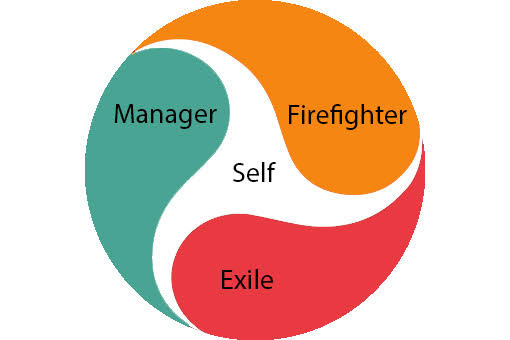
In IFS terms, there’s a protective Part of you whose whole job is making sure you never have to face that moment.
And I’ve heard this part called a hundred different names in sessions:
“The good girl.”
“The fixer.”
“The peacekeeper.”
“The one who doesn’t quit.”
“The part of me that’s exactly like my mom.”
“Honestly? I just call her the idiot.” (Please don’t call her that. She’s been working overtime for you.)
Different names. Same part.
And whatever you call her, she almost always believes some combination of these:
“If I leave, I’m the bad guy.”
“If I just try one more thing, it’ll finally work.”
“Quitting means I failed.”
“If I go, nobody will ever choose me again.”
And she does the same handful of things, over and over:
Researches his attachment style at 1 a.m. instead of asking whether she even likes him.
Rewrites the text six times so it can’t possibly upset him.
Tries to argue that I’m wrong on one of my social media posts instead of having one honest conversation at home. (Hi again. 😅)
There’s some interesting research around this topic, too.
In a set of studies on fear of being single, people with a stronger fear were more likely to prioritize having a relationship over the quality of it, and to stay in ones that were less satisfying.
They didn’t even report lower standards...

They could see the person in front of them wasn’t very caring, yet they were still interested.
That’s why the title of this blog says it’s not low self-esteem. Your standards are fine, your exit is what’s broken.
This Part of you isn’t stupid. She learned, early, that being left (or being the one who “breaks” things) costs everything.
And behind her is usually a younger part carrying something like “I’ll end up alone” or “I’m too much to keep.”
That’s why working harder feels so much safer than leaving.
Effort keeps that younger part quiet. Leaving pokes it right in the chest.
You’re not staying because you love him too much. You’re staying because a Part of you would rather negotiate forever than feel what leaving touches.
So here’s how to actually work with her, instead of fighting her:
Find her in your body. Next time you’re drafting the “can we try one more time” text, stop. Where’s the tightness? Chest? Throat? Gut? Put a hand there.
Unblend. Say it out loud if you can: “A Part of me is terrified of being the one who leaves. She’s a Part of me, not all of me.”
Get curious, not corrective. Ask her, “What are you afraid happens if I go?” “How old do you think I am right now?” Don’t argue with the answer. Just notice how old it feels.
Update her. “You learned this when leaving really did cost us everything. I’m a grown woman now. I can survive being alone. What I can’t keep surviving is spending my 30s negotiating for a text back.”
She’s been making this call for a really long time.
You get to make it now.
Reason #5: Teaching Him Was a Bet on Potential
Every lesson from last week’s blog. Every time you explain the basics again.
Every single one was a bet.
Not on who he is. On who he could be.
And you know I’m gonna say it: love is built on capacity, not potential.
Potential is who he could be under ideal conditions. Capacity is who he consistently is on a random Wednesday when nobody’s watching.

Here’s why this one hits high achievers so hard.
Everywhere else in your life, effort works.
You studied harder, the grade went up. You worked harder, you got promoted. You put in the reps, the results showed up.
So when love doesn’t respond to effort, your brain doesn’t think, “Maybe this isn’t the right guy.”
It thinks, “Must need MORE effort.” (This EXACT belief too me sooooo freaking long to break inside myself…)
But his capacity doesn’t grow because you studied harder.
If you’ve explained the same basic thing three times and gotten three apologies and zero change, you don’t have a communication problem. You have your answer.
That’s not harsh. That’s just data you’ve been refusing to read because you already know what it says.
Why Is the Next One Always the Same Guy?
Ok, but what about the next guy? Love this question, now we’re thinking ahead! :)
So say you finally do leave. Good for you, genuinely.
But the #1 thing I hear a few months later is: “I finally left. And the next one was… the same guy. Different haircut, same guy.”
There’s actually research on this.
Two University of Toronto researchers used a nine-year study out of Germany to compare the personalities of people’s exes and current partners, using the partners’ OWN self-reports.
Across 332 people, current partners described themselves a lot like the exes did, even beyond how much they resembled the person dating them.
So yes. You have a type. (Shocker, I know.)

But having a type isn’t the real reason it keeps going the same way.
The real reason is that nothing about how you left changed.
You left exhausted, not informed.
You left because you finally ran out of gas, not because he crossed a line you’d drawn ahead of time. Which means you never actually found out where your line is.
So the next guy gets the exact same deal the last one did: unlimited chances, on an unlimited timeline, paid for entirely by you.
You can’t always change who you’re drawn to but you can absolutely change what it costs him to stay.
Which brings us to the fun part.
What can you actually do about any of this???
I got you.
The Exit Price Rule
Let’s get practical, baby!! Here’s a 4-step process to decide what a pattern costs you BEFORE you’re attached enough to argue yourself out of it.
Step 1: Write Your No Pile Down Now
Go back to last week’s blog and pull out the basics. The stuff you shouldn’t have to teach a grown man.
Then write your top three as behaviors you could actually see, not feelings you’d have to interpret.
Not “he’s emotionally unavailable.” Try “he cancels plans the same day more than once a month.”

Not “he doesn’t prioritize me.” Try “he goes more than a day without responding when he’s not traveling.”
Three max. If everything’s a dealbreaker, nothing is.
Step 2: Set the Window
You get to say it once. (That’s what last week’s blog was for.)
After that, decide ahead of time: how many misses, over how many weeks?
“Twice in a month after I’ve named it” is a window.
“When I’ve had enough” is not, because “enough” is exactly the thing your nervous system keeps moving.
Step 3: Turn It Into an If-Then, While You Still Feel Nothing for Him
This is the step with the strongest research behind it.
Psychologists call this an implementation intention, it’s a specific “if X happens, then I’ll do Y” plan, decided in advance.
In a meta-analysis of 94 studies, these simple plans had a medium-to-large effect on actually following through on goals.
And one of the things they specifically helped with was getting people to disengage from courses of action that weren’t working.
Which is… literally this relationship.

So write it out, in plain words: “If he cancels same-day twice after I’ve named it, then I end it that week.”
Do this in the first few dates, BEFORE the oxytocin and the good weeks show up and start lobbying on his behalf.
Then tell one friend you trust, so somebody outside your nervous system knows the deal too.
Step 4: When the Price Hits, Leave on the Rule, Not the Feeling
When he hits the line, that Part from Reason #4 is gonna show up with “just one more try.”
Expect it. It’s not a sign you’re wrong.
Luckily enough, people generally predict they’ll feel way worse after a breakup than they usually do, so this isn’t a reason not to do it!
A line you drew while you were clear-headed is worth more than any decision you’ll make at 1 a.m. after another “we need to talk.”
Leaving Early Isn’t Cold
I know leaving early can feel harsh. Like you didn’t give him a real chance. Like you’re the bad guy in his story.
But a clear ending at the price you set isn’t cold.
It’s the most honest information you can give both of you.
He learns the basics were never optional, and you learn you can finally trust yourself to act on what you see.
You already know how to notice. You’ve been noticing since date two.
Now you get to be the woman who believes herself the first time.
You don’t need to try harder. You need to leave sooner.
You’ve got this.
And as always… Live Heroically 🧠
Wrecked to Regulated in 63 Days
Start Here: She Rises Community.
Inside is a 63-day program of the exact things I did myself to go from wrecked to regulated using neuroscience.
Plus, You’ll Have Access To:
A 63-day program to go from wrecked to regulated
Live coaching calls with me every week
A team of IFS practitioners
Private workshops and masterclasses with therapists and scientists
1-on-1 sessions
A room full of women doing this beside you
If you’re ready to become emotionally available, develop secure attachment, and attract healthy potential partners, this is for you!
The first 7 days are free. Join below!
Leave a Comment
What’s kept you in a place you know you should leave? Drop it below!
Supporting Research
Rusbult, C. E. (1980). Commitment and satisfaction in romantic associations: A test of the investment model. Journal of Experimental Social Psychology, 16(2), 172-186.
Rusbult, C. E., Martz, J. M., & Agnew, C. R. (1998). The Investment Model Scale: Measuring commitment level, satisfaction level, quality of alternatives, and investment size. Personal Relationships, 5(4), 357-391.
Le, B., & Agnew, C. R. (2003). Commitment and its theorized determinants: A meta-analysis of the Investment Model. Personal Relationships, 10(1), 37-57.
Le, B., Dove, N. L., Agnew, C. R., Korn, M. S., & Mutso, A. A. (2010). Predicting nonmarital romantic relationship dissolution: A meta-analytic synthesis. Personal Relationships, 17(3), 377-390.
Joel, S., Impett, E. A., Spielmann, S. S., & MacDonald, G. (2018). How interdependent are stay/leave decisions? On staying in the relationship for the sake of the romantic partner. Journal of Personality and Social Psychology, 115(5), 805-824.
Spielmann, S. S., MacDonald, G., Maxwell, J. A., Joel, S., Peragine, D., Muise, A., & Impett, E. A. (2013). Settling for less out of fear of being single. Journal of Personality and Social Psychology, 105(6), 1049-1073.
Eastwick, P. W., Finkel, E. J., Krishnamurti, T., & Loewenstein, G. (2008). Mispredicting distress following romantic breakup: Revealing the time course of the affective forecasting error. Journal of Experimental Social Psychology, 44(3), 800-807.
Clark, A. (2013). Whatever next? Predictive brains, situated agents, and the future of cognitive science. Behavioral and Brain Sciences, 36(3), 181-204.
Ferster, C. B., & Skinner, B. F. (1957). Schedules of Reinforcement. Appleton-Century-Crofts.
Fiorillo, C. D., Tobler, P. N., & Schultz, W. (2003). Discrete coding of reward probability and uncertainty by dopamine neurons. Science, 299(5614), 1898-1902.
Park, Y., & MacDonald, G. (2019). Consistency between individuals’ past and current romantic partners’ own reports of their personalities. Proceedings of the National Academy of Sciences, 116(26), 12793-12797.
Schwartz, R. C., & Sweezy, M. (2020). Internal Family Systems Therapy (2nd ed.). Guilford Press.
Gollwitzer, P. M., & Sheeran, P. (2006). Implementation intentions and goal achievement: A meta-analysis of effects and processes. Advances in Experimental Social Psychology, 38, 69-119.
Campbell, J. C., Webster, D., Koziol-McLain, J., et al. (2003). Risk factors for femicide in abusive relationships: Results from a multisite case control study. American Journal of Public Health, 93(7), 1089-1097.
This article is educational in nature and not a substitute for therapy. If attachment wounds or relational trauma are impacting your well-being, working with a trauma therapist can help your nervous system relearn safety in connection.