

TL;DR Summary:
There’s a skill smart women are really proud of that can pass for emotional availability. It fools them about themselves before it fools anyone else…
Knowing exactly why he’s pulling away and being able to do something about it live in two different places. One is in your head. The other isn’t.
The breakup that “came out of nowhere” almost never did. The signal got there. Something else just got there faster.
There are three scores that decide how blindsided you’ll be, and you’re probably grading yourself on the wrong one.
Your growth edge is a number. It’s not the one you’re proud of.
Inside: a back-of-the-napkin way to score yourself, and one boring little rep for whichever number comes in lowest.
You Wrote His Case File
She’d already diagnosed him.
Dismissive-avoidant. Emotionally checked-out dad. Deactivates every time things get close.
She’d read the books. She’d done years of therapy. She had (lovingly, she swears) explained his attachment style to him over dinner.
Three weeks later he ended it over text, and she sat across from me in session and said the word I hear more than almost any other: “I was blindsided.”
Blindsided…
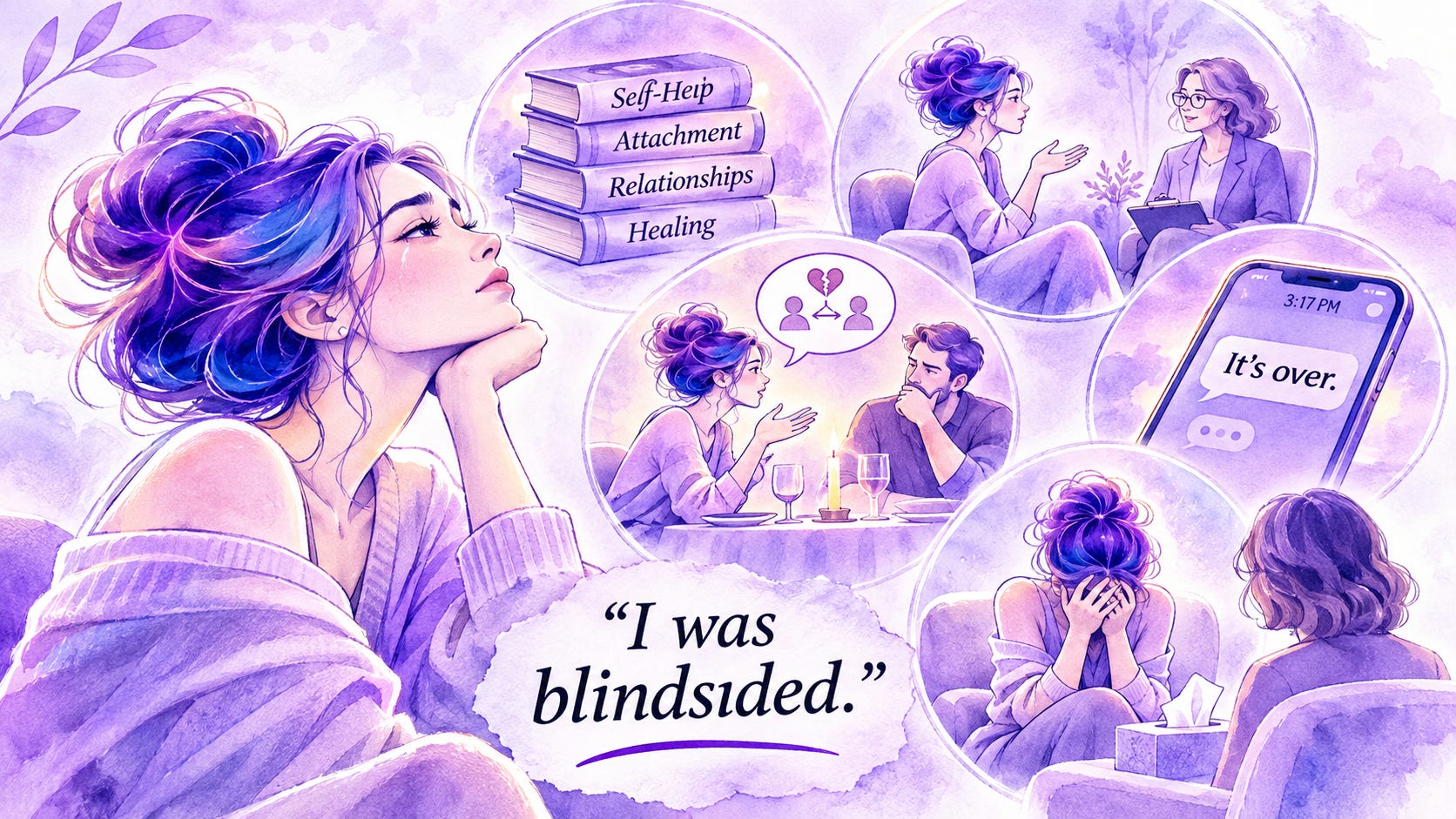
Were you blindsided, or did you see every single thing, but explained it so well that you never did anything about the things you saw?
I know which camp I was in after my “blindsiding” breakup…
It’s a tough pill to swallow, but it’s necessary medicine if you want to prevent it from happening again.
I’m very passionate about this topic, not only from my own lived experience and lessons learned, but because I hear some version of this plea nearly every single day.
And it’s almost always from the smartest, most self-aware women I work with.
It’s not a perception problem. Your eyes are fine.
It’s that you’ve got one of three skills maxed out, and you’ve been letting it cover for the other two.
Those three are secure attachment, emotional intelligence, and emotional availability.
These are, without a doubt, the most misunderstood concepts in all of psychology if you ask me!
From the outside, they look like the same thing. They’re not, and the gap between them is exactly where the “out of nowhere” breakups come from.
So, today, we’re gonna separate them, look at how the one you’re best at impersonates the others, figure out how this sets you up to get blindsided, and then teach you how to prevent this from happening again.
I wish I had this blog much earlier in my life…
Let’s dive in!
Three Circles That Look Like One
Picture three circles side by side: secure attachment, emotional intelligence, emotional availability.
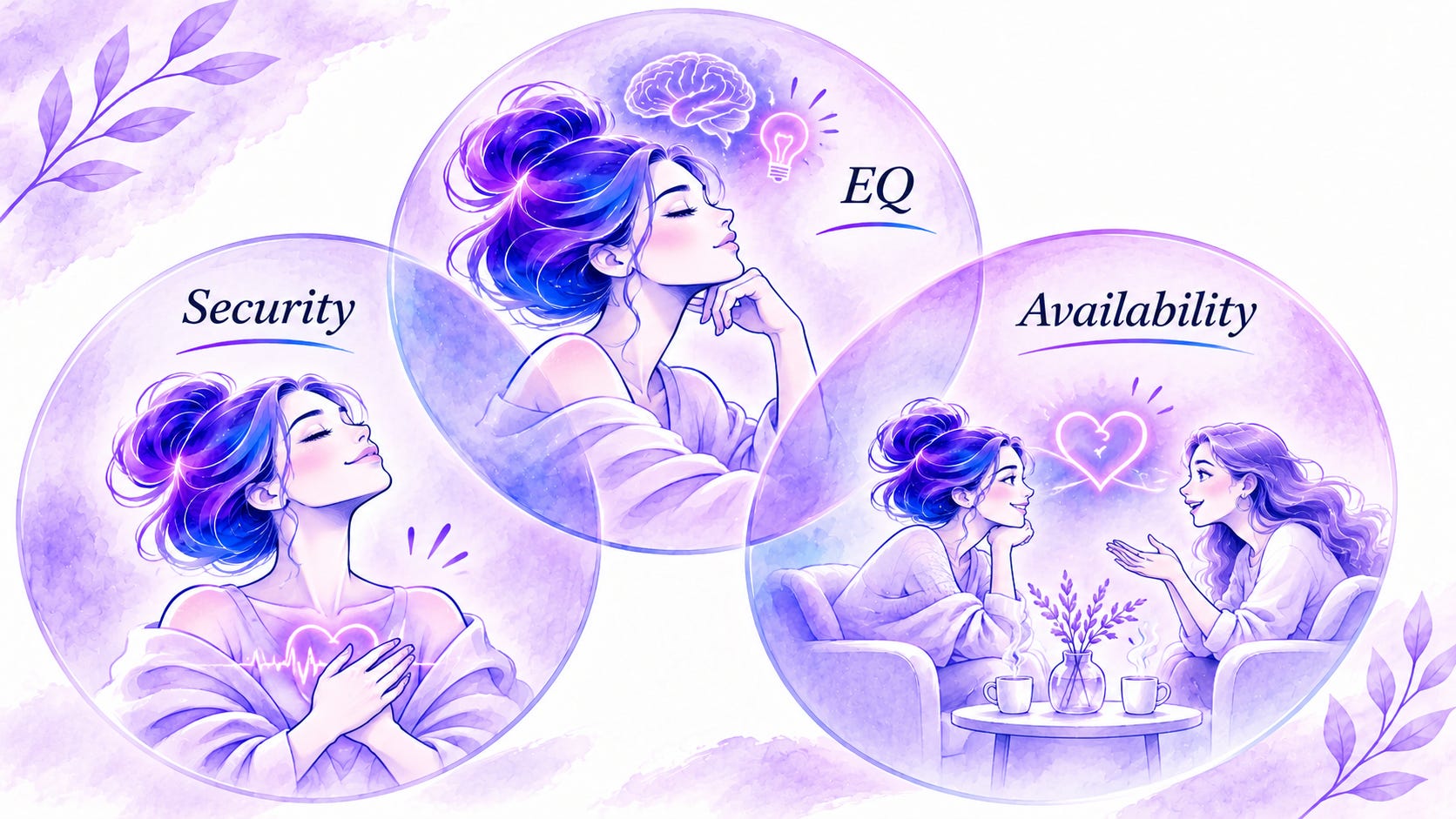
On a good day, they look identical. But each one lives somewhere different, and that’s the whole game.
Secure Attachment Lives in Your Nervous System
Secure attachment is an internal sense of safety.
Not an opinion about safety. A default setting.
It sounds like: “Even when this is hard, my nervous system knows it’ll be ok, and we’ll figure it out.”
Attachment researchers describe it this way: when something threatens the connection, a secure system doesn’t have to crank up the protest (chasing, checking, needing reassurance) or shut the whole thing down (going cold, going quiet).
It can turn toward the other person and trust the bond holds.
That expectation runs automatically, below thought. Which is exactly why you can’t think your way into it.
Imagine he doesn’t text back by 9pm.
The secure version of you notices, has a little “huh,” and goes to bed. Not because she decided not to care. Because her body never sounded the alarm in the first place.
Emotional Intelligence Lives in Your Head
Emotional intelligence is a skill.
The research version of this skill is the ability to perceive, understand, name, and manage emotions in yourself and other people.
It sounds like: “I know exactly why I’m activated right now and can name it.”
Imagine the same scene from before. 9pm, no text.
The high-EQ version of you goes: “Ok. I’m activated. This is my abandonment stuff. He’s probably deactivating because we had such a close weekend. Classic.”
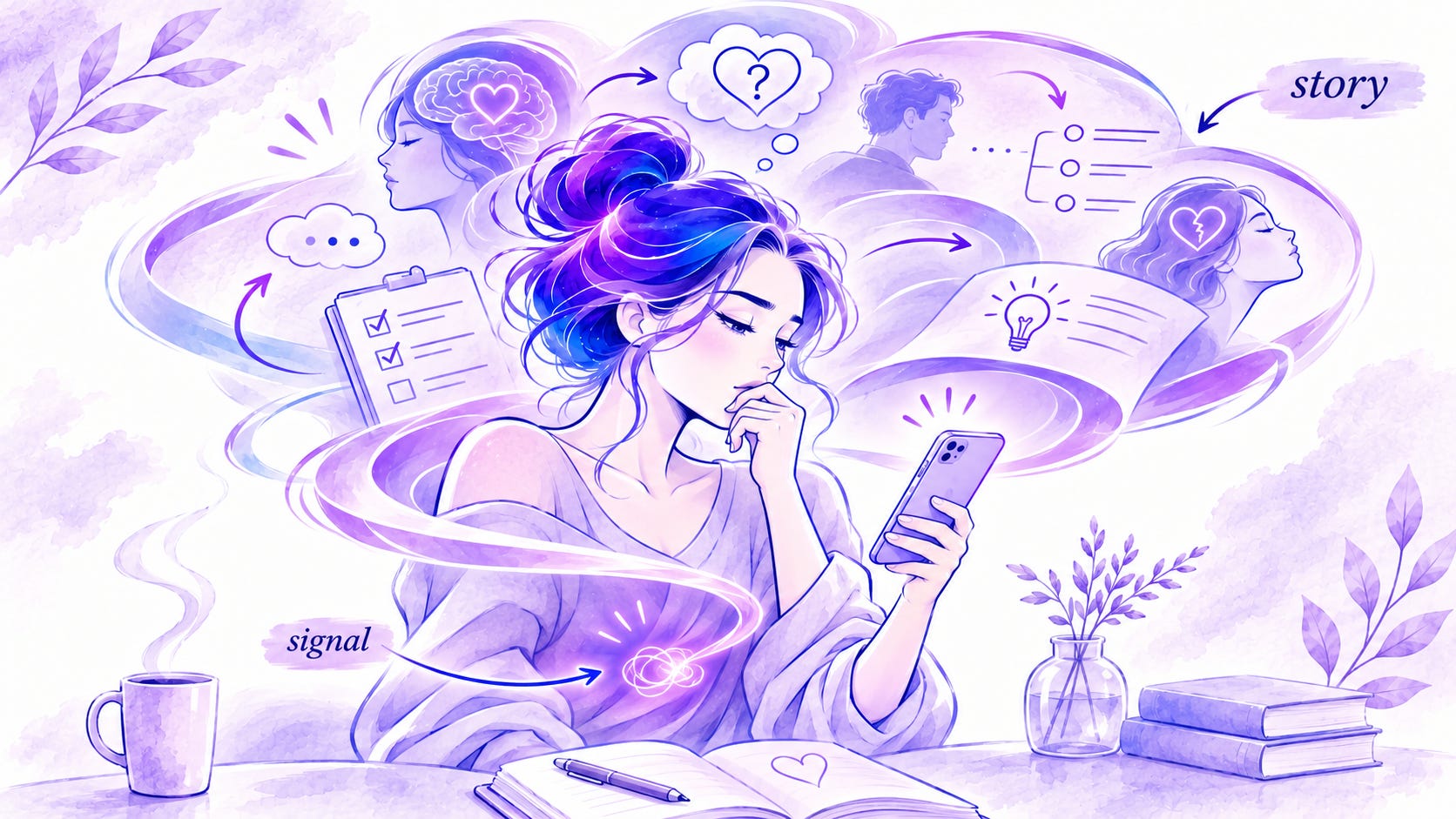
Every word of that might be accurate.
She’s also still awake at 1am, re-reading the thread.
EQ is real, and it’s valuable. It’s the map. It is not the territory, and it was never designed to make you feel safe.
The euphemism for this one? “I’m super self-aware.” (And you are. That’s kinda the problem...)
Emotional Availability Lives in the Room
Emotional availability is a live behavior. It’s a vulnerability, in real time, with another person in the room.
It sounds like: “Here’s what I haven’t figured out yet...”

The term actually comes out of parent and child research, where it describes how emotionally reachable a caregiver is in the moment.
Not what they know about the kid… Whether the kid can get to them.
Same idea in adult love.
And intimacy research backs it: in diary studies of everyday conversations, sharing feelings predicted closeness more than sharing facts did, and how responsive the other person was carried a lot of that effect.
Ok, same 9PM scene, one more time!
The available version of you says the next day: “Hey, I noticed I got kinda anxious when I didn’t hear from you last night. Not mad. Just telling you.”
Messy. Unpolished. Said while it’s still happening, not after it’s all figured out.
The euphemism here is “I’m a private person” or “I like to process on my own first.” Translation: I’ll let you in once there’s nothing left to see.
The Rain
Here’s the easiest way to keep all of these straight.
EQ is telling me it’s raining. Availability is standing out in the rain with someone. Secure attachment is the core belief you’ll survive this storm, and the next ones.

The rain is the hard emotional moment. Knowing it’s happening is EQ. Being in it together is availability. Trusting you come out the other side is security.
Where I see most people get stuck, myself included, is that you can give a gorgeous, detailed weather report from inside a house with every door locked…
And that’s because one of these circles has a real talent for dressing up as the other two.
The Imposter
The cruelest part for the high-EQ crowd is that EQ can impersonate availability.
Availability involves talking about feelings.
EQ is REALLY good at talking about feelings.
So from the outside (and honestly, from the inside too) fluency looks exactly like openness.
The giveaway is what I call curated disclosure.
You’re “open” about the wound you healed three years ago, and a vault about the thing you’re scared of tonight.

Here’s what it tends to sound like:
“My dad left when I was nine, and I’ve done a lot of work around that.” (Healed. Packaged. Safe to share.)
“I used to be really anxious in relationships.” (Used to. Past tense. Very convenient.)
“I know I can be a lot sometimes.” (A preemptive strike dressed up as a confession.)
What’s missing from all three? Anything happening right now, between the two of you, that you don’t have an answer for yet.
Here’s why this happens. EQ is a skill, and skills serve whoever’s driving.
There’s a study from the University of Toronto that I love for this. They measured how good people were at managing emotions, theirs and other people’s.
In people who really cared about being good, that skill made them more generous.
In people with a manipulative streak? The exact same skill made them better at undermining their coworkers.
Same skill. Different driver.
I’m not saying you’re manipulative; I’m saying EQ is an amplifier, not a compass.
When a protective Part of you is in the driver’s seat, EQ just makes the protection more skillful.
And yes, this runs both directions.
You’ve met him. He talks about his attachment wound on date two.
He uses “regulate” correctly in a sentence. He tells you he’s “doing the work.”
He feels like the most emotionally available man you’ve ever dated.
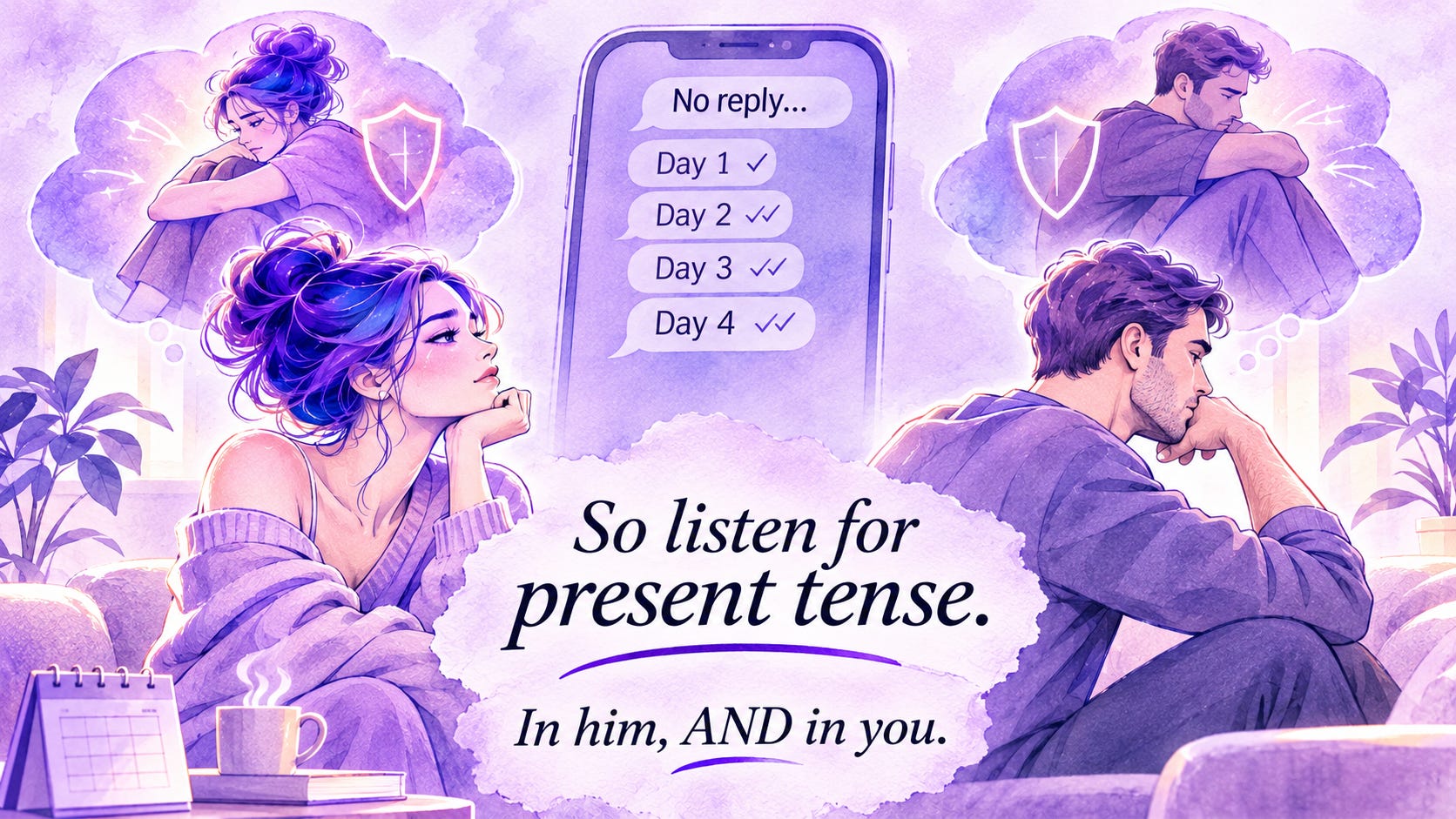
Then the first time something’s raw between you, he goes quiet for four days…
He wasn’t lying to you. His protector was doing the exact same thing yours does: talking fluently about the past so nobody gets near the present.
So listen for present tense. In him, AND in you.
You Saw It. You Just Explained It.
Back in January, I wrote a blog called Could You Have Prevented Your Discard? (No.)
I stand by it. You can’t make someone with low capacity stay.
But preventing it and seeing it are two different things.
And most of the time? You saw it.
The signal showed up in your body first. The little drop in your stomach when he said “I’ve just been slammed at work.” The tight chest when the goodnight texts got shorter.
Then your EQ produced a story fast enough and reasonable enough that you never had to act on what your body already knew.
So the conversation that would have surfaced it never happened.
And when it ended, it felt sudden, because from your head’s point of view, everything. had been explained.
You weren’t blind. You got out-talked by your own insight…
How that plays out depends on your scores in the 3 areas we just learned about.
Here are the four combos I see most in my clients and followers.
High EQ, Low Security: “It’s Probably Just My Anxiety.”
Every signal gets filed under your own stuff.
Because you know you run anxious, you assume any alarm is the alarm crying wolf again. So when he goes cold, your EQ says “that’s just my wound talking,” and you self-soothe right past real data.
What It Looks Like
A few telltale moves:
You journal about it instead of asking him about it.
You ask your therapist what’s wrong with you instead of asking him what’s going on.
You say “I don’t wanna be that girl” and then become a very quiet, very calm, very miserable girl instead.
Sometimes the alarm is old. Sometimes it’s accurate.
You can’t tell which from inside your own head, and the only way to find out is to say it out loud to him.
That’s not your EQ’s job.
High EQ, Low Availability: “I’ll Bring It Up Once I’ve Figured Out How I Feel.”
You knew something was off. You knew for weeks.
But you were waiting until you’d processed it enough to present it well. Calm. Articulate. Fair to both sides.
BUT, he ended it before you finished your draft…
What You’ll Notice
This one usually shows up as:
Rehearsing the conversation in the shower for the eleventh time.
Texting your best friend the full, color-coded analysis while texting him “I’m good! :)”
Framing a real need as a joke so it can’t technically get rejected.
The relationship didn’t fail the test. It never got the test.
Low Security, Low Availability: “I’ll Just Wait and See.”
You saw it, and you felt it like a fire alarm. Then you said nothing and held your breath.
This one isn’t explaining it away. It’s freezing.
You watch his texts, you track his tone, you wait for him to make it clear, and you never once say what you’re seeing.
It feels like a blindside because you never let yourself call it.
But waiting isn’t neutral.
It’s a decision to let him make all the decisions.
High Scores in All 3: “This Isn’t Working, and I’m Gonna Say So.”
Let me be really clear: you can still get left.
Secure, emotionally intelligent, available women get broken up with all the time.
Capacity mismatch is real, and you don’t control his.
What you don’t get is blindsided. You noticed it, named it, said it to him while it was still messy, and trusted you’d survive whatever he said back.
It still hurts. It just doesn’t ambush you.
(And if you’re the rare one with high security and lower EQ? You might miss some of the subtle stuff, but you’re also the least likely to spiral when it ends. Lucky you, honestly.)
Alright. So which one are you?
Lemme give you a way to actually find out, and fair warning, it’s gonna be kinda annoying :)
The Napkin Score
Rate yourself 1 to 10 on each circle.
The trick: rate from your behavior, not your knowledge.
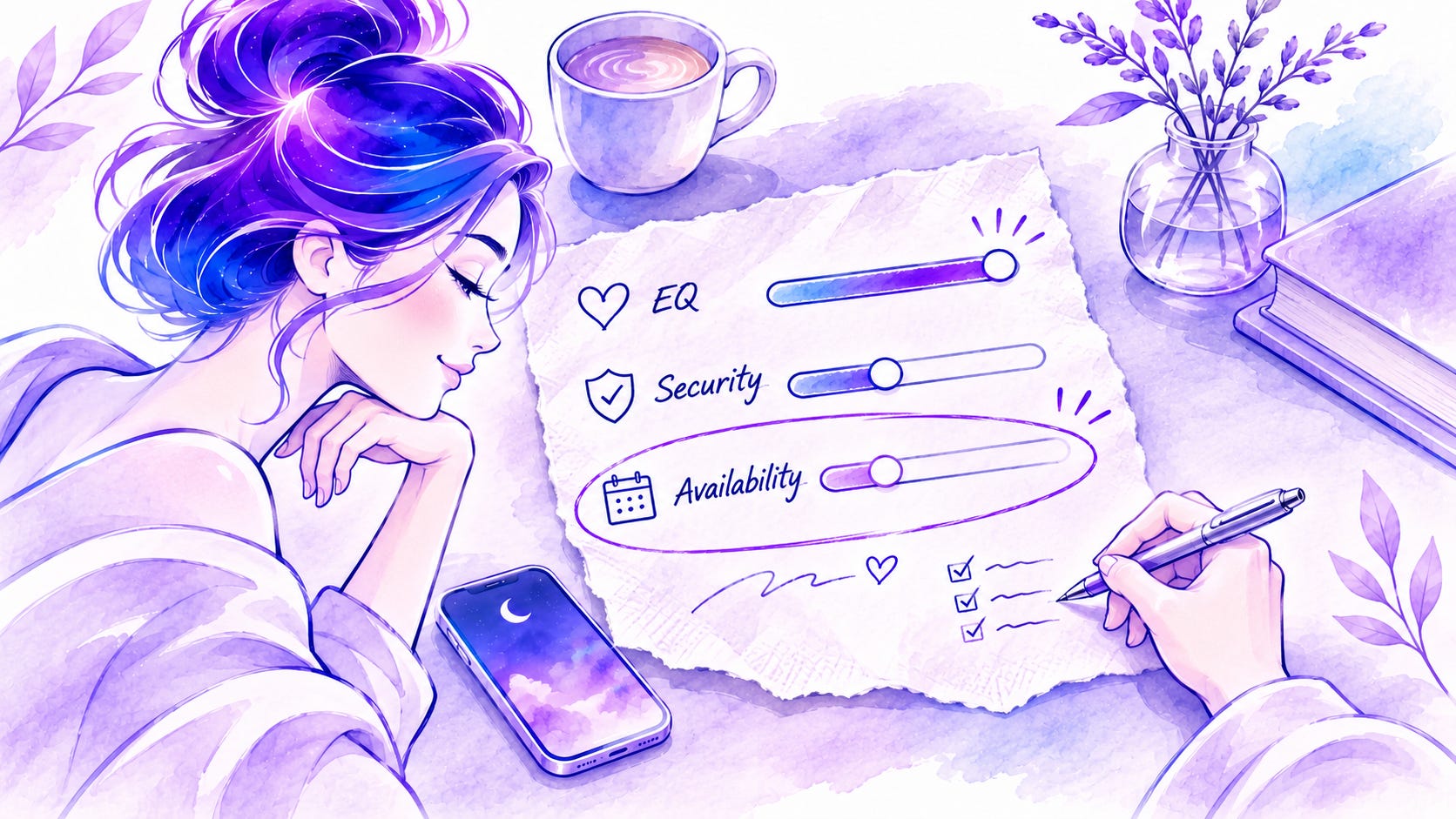
Smart people are amazing at grading what they know and pretty rough at grading what they do.
So for every question, picture the last three times it actually came up, and score those.
Obviously, this is not a validated test for any of these; it’s just a back-of-the-napkin way to see where you’re at.
EQ: When emotions show up, can I notice, name, and make sense of them?
A couple anchors to calibrate:
A 3 is: “Fine” and “stressed” are your whole vocabulary, and you figure out you were upset two days later.
A 7 is: You can name it in the moment and usually know where it came from.
Most of you: high. Like, annoyingly high.
Your Score: ______
Secure Attachment: In my body, by default, do I expect people to be safe and to stay? Not “do I know I should.” Do I actually feel it?
Anchors for this one:
A 3 is: A slow reply hijacks your whole evening, and you need reassurance to come down.
A 7 is: You notice the gap, feel a little twinge, and it passes without you having to do anything about it.
Your Score: ______
Availability: When something’s raw and unresolved, can I let someone reach me in real time, or do I disappear, perform, or wait until I’ve got it handled?
And for availability:
A 3 is: People find out about your hard stuff after it’s over, as a story with a lesson at the end.
A 7 is: You can say “I don’t know what I feel yet, but something’s off” to someone who matters.
Your Score: ______
Now circle your lowest number.
Your growth edge is your lowest number. NOT your favorite number. Your lowest number!!!
A 10 out of 10 in understanding does not make up for a 4 out of 10 in feeling safe, or a 3 out of 10 in being reachable.
That’s the whole reason “but I’m so self-aware” never protected you.
And please, stop trying to turn your 9 in EQ into a 9.5.
Another attachment book. Another podcast. Another reel explaining avoidants. (I see you saving them. I make some of them lol.)
The 9 is done. The work is the score you’ve been ignoring.
When I point this out in session, the most common response is “I just wanna understand it a little more first.”
Understanding is how the 9 stays busy so the 4 never has to show up.
Ok, Cody, I’ve got my number. What do I do about it???
Glad you asked :)
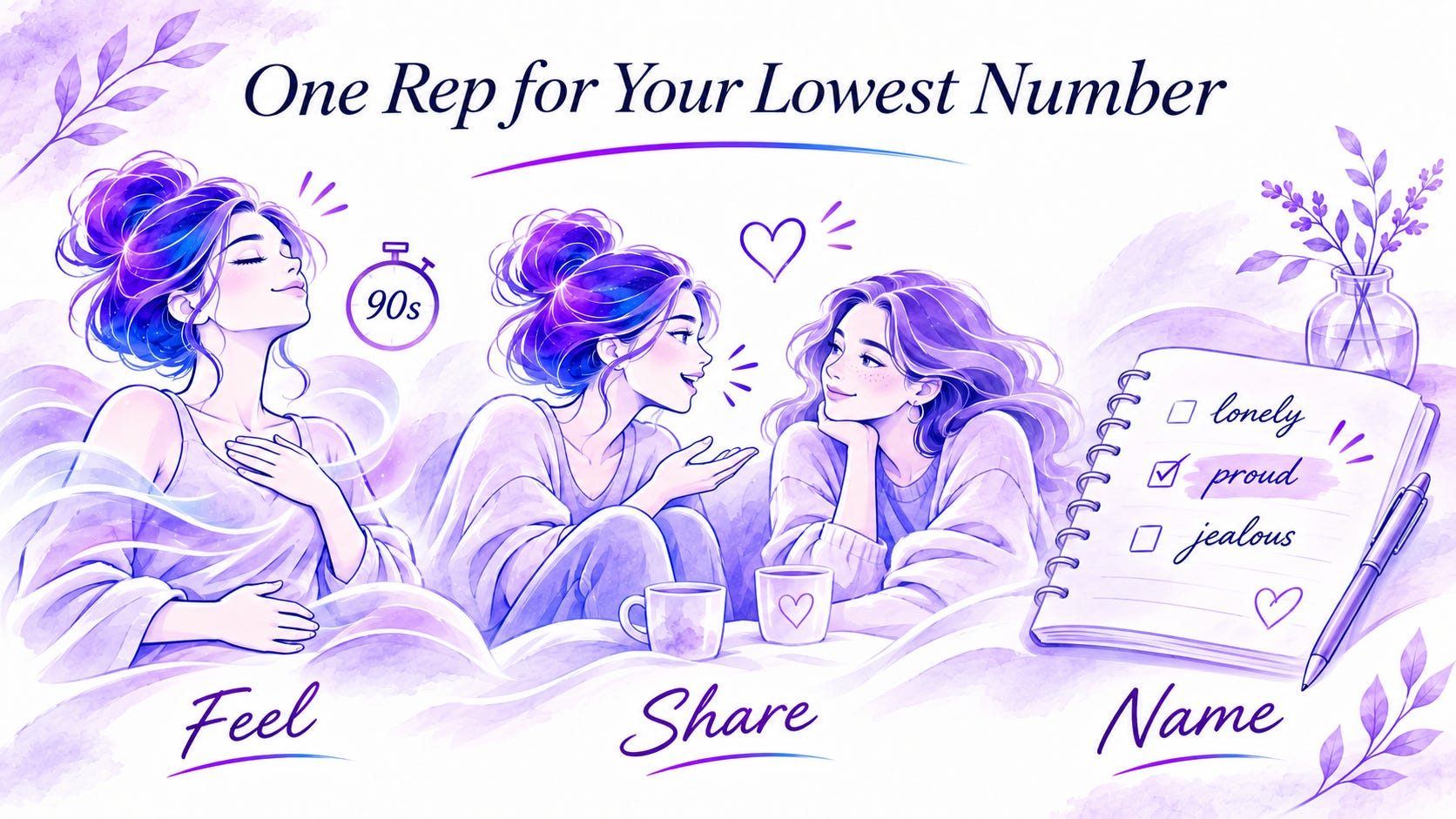
One Rep for Your Lowest Number
One rep, aimed at your lowest score. Not three. Not a 30-day overhaul.
ONE. Rep
Rep #1 (Low Security): Feel It for 90 Seconds
Next time you get triggered (the cold text, the silence, the pull-away), don’t analyze it. Don’t figure out his attachment style. Put the book down, ma’am.
Just feel it in your body for 90 seconds without doing one single thing about it.
Where is it? Chest, throat, stomach? Is it tight, hot, buzzing? You can name it plainly (”scared, tight chest”), but no story. No why. No plan.

The 90 seconds comes from neuroanatomist Jill Bolte Taylor. Treat it as a target, not a law. Some waves take longer, and that’s fine.
The principle underneath it is solid, though.
Exposure research shows fear updates when you stay with the feeling, and the catastrophe you expected doesn’t show up.
Your brain logs new information: that happened, and I’m still here.
You’re teaching your nervous system, from the bottom up, that the wave moves through and you survive it.
That’s what security is, built one rep at a time.
(If you speak IFS: this is letting the scared Part be there without the analyst Part grabbing the mic. “A Part of me is terrified he’s leaving.” Notice it. Don’t fix it.)
Rep #2 (Low Availability): One Unhandled Thing
This week, tell one safe person one real thing you haven’t figured out yet.
The messy version, while it’s still messy. Let yourself be seen mid-mess, not after the win.

Pick someone safe first. Your best friend, your sister. Not the guy who’s ghosted you twice. (Please, God.)
It might sound like:
“I’m weirdly jealous of her engagement, and I don’t know what to do with that.”
“I think I’m lonelier than I’ve been letting on.”
“I don’t actually know if I want this job anymore.”
One rule: no bow on it. No “but I’m working on it!” at the end.
Closeness gets built when feelings, not facts, land on someone who responds.
The finished stuff is a TED talk.
The unfinished stuff is what lets someone actually reach you.
Rep #3 (Low EQ): Name One Feeling a Day
Rare in the crowd that reads my stuff, but real.
If this is you, once a day, name one feeling.
Make it specific.
Not “fine,” not “stressed.” Irritated. Lonely. Proud. Embarrassed. Jealous.
Dr. Matthew Lieberman’s lab at UCLA found that putting a feeling into words turned down amygdala response and turned up activity in a region of the prefrontal cortex involved in regulation.
Naming it gives your brain a handle on it.
These are small reps. They’re boring. They’re unsexy, as always…
And they’re the core skills of actual intimacy.
Every one of them can be practiced, and every one of them gets better with reps.
Knowing Was Never the Finish Line
You didn’t miss it. You knew. Knowing was just never the hard part for you.
The next relationship doesn’t need you smarter.
It needs you reachable, and steady enough to stay reachable when it gets scary.
So score yourself.
Find your lowest number.
Do one rep this week, and let it be boring.
You’ve got this!
And as always… Live Heroically 🧠
Wrecked to Regulated in 63 Days
Start Here: She Rises Community.
Inside is a 63-day program of the exact things I did myself to go from wrecked to regulated using neuroscience.
Plus, You’ll Have Access To:
A 63-day program to go from wrecked to regulated
Live coaching calls with me every week
A team of IFS practitioners
Private workshops and masterclasses with therapists and scientists
1-on-1 sessions
A room full of women doing this beside you
If you’re ready to become emotionally available, develop secure attachment, and attract healthy potential partners, this is for you!
The first 7 days are free. Join below!
Leave a Comment
Drop your scores below! I’d love to see where everyone lands.
Supporting Research
Fraley, R. C., Waller, N. G., & Brennan, K. A. (2000). An item response theory analysis of self-report measures of adult attachment. Journal of Personality and Social Psychology, 78(2), 350-365.
Mikulincer, M., & Shaver, P. R. (2016). Attachment in adulthood: Structure, dynamics, and change (2nd ed.). Guilford Press.
Mikulincer, M., Shaver, P. R., & Pereg, D. (2003). Attachment theory and affect regulation: The dynamics, development, and cognitive consequences of attachment-related strategies. Motivation and Emotion, 27(2), 77-102.
Brackett, M. A., & Mayer, J. D. (2003). Convergent, discriminant, and incremental validity of competing measures of emotional intelligence. Personality and Social Psychology Bulletin, 29(9), 1147-1158.
Brackett, M. A., Rivers, S. E., Shiffman, S., Lerner, N., & Salovey, P. (2006). Relating emotional abilities to social functioning: A comparison of self-report and performance measures of emotional intelligence. Journal of Personality and Social Psychology, 91(4), 780-795.
Côté, S., DeCelles, K. A., McCarthy, J. M., Van Kleef, G. A., & Hideg, I. (2011). The Jekyll and Hyde of emotional intelligence: Emotion-regulation knowledge facilitates both prosocial and interpersonally deviant behavior. Psychological Science, 22(8), 1073-1080.
Kafetsios, K. (2004). Attachment and emotional intelligence abilities across the life course. Personality and Individual Differences, 37(1), 129-145.
Rosso, A. M. (2022). Ability emotional intelligence, attachment models, and reflective functioning. Frontiers in Psychology, 13, 864446.
Biringen, Z. (2000). Emotional availability: Conceptualization and research findings. American Journal of Orthopsychiatry, 70(1), 104-114.
Laurenceau, J.-P., Barrett, L. F., & Pietromonaco, P. R. (1998). Intimacy as an interpersonal process: The importance of self-disclosure, partner disclosure, and perceived partner responsiveness in interpersonal exchanges. Journal of Personality and Social Psychology, 74(5), 1238-1251.
Bolte Taylor, J. (2008). My stroke of insight: A brain scientist’s personal journey. Viking.
Craske, M. G., Treanor, M., Conway, C. C., Zbozinek, T., & Vervliet, B. (2014). Maximizing exposure therapy: An inhibitory learning approach. Behaviour Research and Therapy, 58, 10-23.
Kircanski, K., Lieberman, M. D., & Craske, M. G. (2012). Feelings into words: Contributions of language to exposure therapy. Psychological Science, 23(10), 1086-1091.
Lieberman, M. D., Eisenberger, N. I., Crockett, M. J., Tom, S. M., Pfeifer, J. H., & Way, B. M. (2007). Putting feelings into words: Affect labeling disrupts amygdala activity in response to affective stimuli. Psychological Science, 18(5), 421-428.
Schwartz, R. C., & Sweezy, M. (2020). Internal Family Systems therapy (2nd ed.). Guilford Press.
This article is educational in nature and not a substitute for therapy. If attachment wounds or relational trauma are impacting your well-being, working with a trauma therapist can help your nervous system relearn safety in connection.