

TL;DR Summary:
Quick version, before I get into it:
A brand new set of four studies finally separated “he popped up in my feed” from “I went looking.” Your brain does NOT treat those the same.
One of them mostly wears off by bedtime. The other one is still billing you the next morning.
Why picturing his Instagram stings worse than picturing him at work (same guy, same breakup)
The women for whom even accidental sightings aren’t free… and why it’s probably you
What to do instead, starting tonight, no dramatic blocking required
“I wasn’t stalking him. I was just seeing if he was okay.”
Riiiggghhhttttttt…
If I had a penny for every time I heard this statement in my DMs, my community, my comments, and my client calls, I’d be a rich man.
A few of my recent favorites:
“I just wanted to see if he looked sad.”
“I wasn’t looking at HIM, I was looking at who he started following.”
“I only watched his best friend’s stories. Which is different.”
“I just needed to know if she’s prettier than me.” (She’s not the point. I’ll get there.)
“I used my old account so it wouldn’t show up as me.” (Lmao. The commitment though...)
Researchers have a name for all of this, and it isn’t “a quick peek.”
It’s called interpersonal electronic surveillance.
Surveillance. Like the CIA, but with more crying.
A woman in my community posted about exactly this a few weeks ago.
Facebook put a video of her ex in her feed. It was an event in a community they both belong to, one she’s been skipping just so she won’t run into him.
She didn’t go looking. It just showed up..
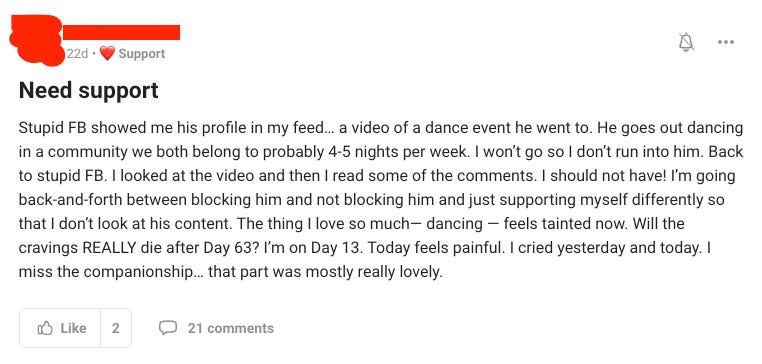
So she watched it.
Then she read the comments and, in her words, she ruminated about it “for HOURS and HOURS.”
The next day she felt defeated, said it was bleeding into other parts of her life, and was wondering if she should restart no contact back at Day 1.
One video. That’s all it took.
And I’m not above this; let me be very clear.
After my last big breakup, my version ran the other direction: posting stuff in subtle ways, lowkey hoping she or one of her friends would see it and realize what she fumbled.

When I ask women why they check, almost everyone gives me the same answer: she’s gathering information.
She needs to know where things stand so she can finally move on.
Makes sense, emotionally, maybe...
HOWEVER, new research is out on this exact behavior, and “finally moving on” is unfortunately not what’s happening.
Checking isn’t information gathering. It’s a two-day tax on your nervous system, and today, I’ll show you what that tax is, and of course, how to stop paying it :)
Let’s dive in!
“Saw Him” vs. “Went Looking”
Social psychologist Tara Marshall has been studying this exact behavior since 2012.
Her early work found that people who kept checking an ex’s profile reported more breakup distress, more longing for the ex, and less personal growth.
But that study had a problem. It couldn’t tell what was causing what.
Maybe checking made people miserable. Maybe miserable people just checked more.
So her newest work came back with four studies and 762 people who’d recently been through a breakup:
A six-month follow-up of people fresh out of a breakup
An experiment that randomly assigned people to imagine different scenarios
Two diary studies where people logged every night whether they’d seen their ex online and how they felt
And critically, she split exposure into two kinds:
Passive: he pops up in your feed. You didn’t go looking. (Thanks, algorithm.)
Active: you typed his name. Or tapped into his profile. Or her profile. Or his mom’s. (You know what you did…)
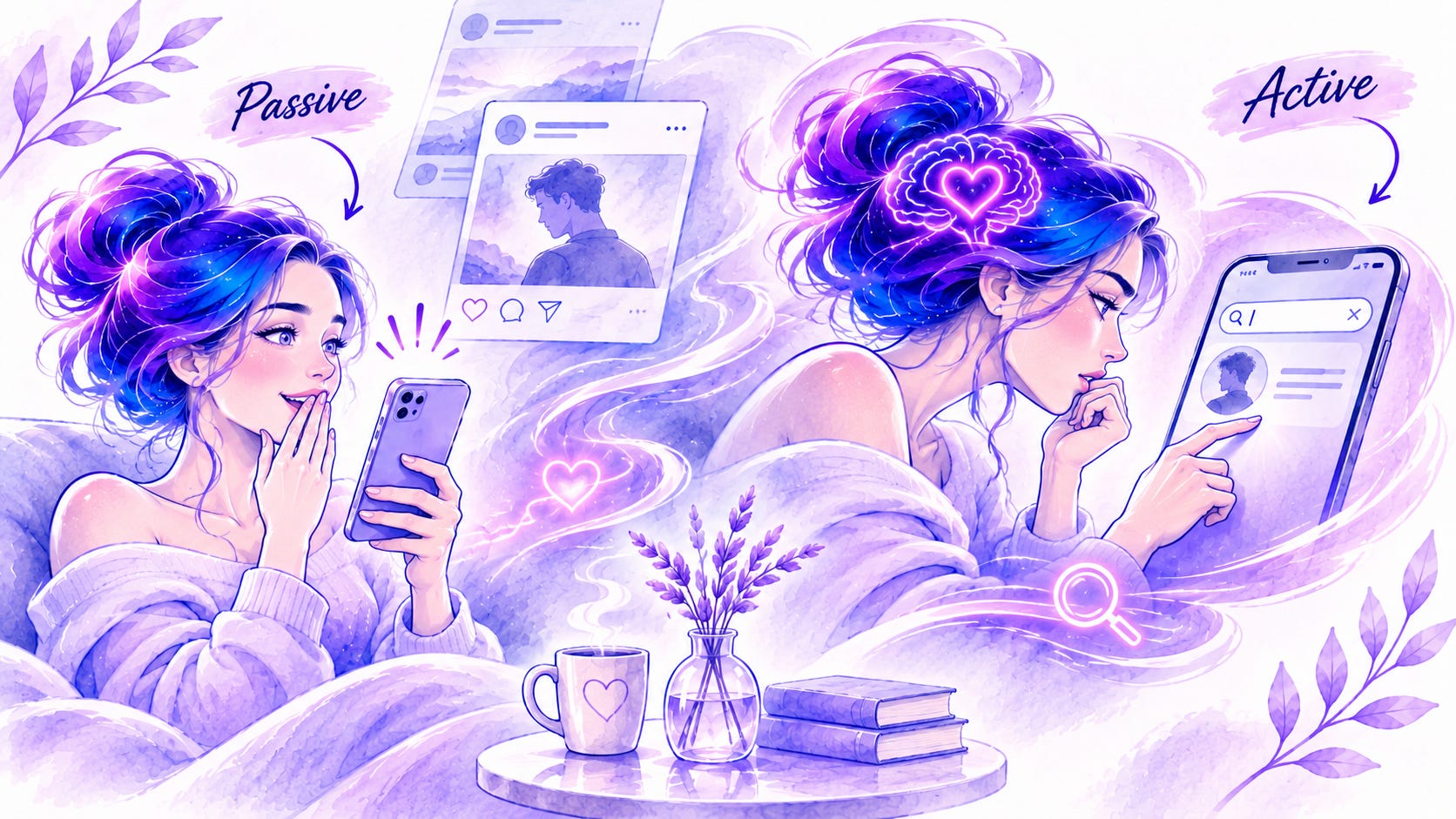
Accidental sightings were linked to a worse mood that same day. Annoying. Not great. But in the diary data she collected, it mostly stayed in its lane.
Deliberate searching was linked to more breakup distress that day, AND it predicted more breakup distress the next day.

Wild, right?
The search didn’t just cost her the evening. It showed up again in the morning.
Dr. Marshall calls it an emotional hangover.
I call it a tax, because you pay it twice and nobody asked if you wanted to.
The experiment is the part I can’t stop thinking about, though.
People who imagined looking at their ex’s social media profile felt more jealous than people who imagined an acquaintance’s profile.
And more jealous than people who imagined their ex at work or school.
Same guy. Same breakup. The only thing that changed was the frame he showed up in.
And that jealousy went hand in hand with more negative feelings and more breakup distress.
The problem isn’t seeing him. It’s seeing the SOCIAL MEDIA FEED version of him.

Now, these diary findings are correlations, so they can’t prove searching causes the next-day crash.
And the diary groups were college students, which is not exactly a room full of 34-year-old surgeons.
But four studies, four methods, three countries, a handful of platforms, all pointing the same direction?
That’s about as solid as this kind of research gets.
Why Going Looking Costs More Than Bumping Into Him
So why does the search follow you to bed when the accidental sighting mostly doesn’t?
Think about what’s going on in your brain when you open his profile on purpose.
You’re not bored. You went in with a question:
Is he okay without me?
Is he happier?
Is there someone new?
Did he even care?
And his profile can’t answer a single one of those.
It’s a highlight reel. Him at a bar. Him at a wedding. Him looking annoyingly good in a hoodie.
In Dr. Marshall’s work, the posts that stung most were the ones where the ex looked good, looked like he was having fun, or looked like he was moving on, even with no new partner anywhere in the picture.
The one that stung me the most was one of her at a cool event with a friend where it looked like she was 100% ok after ripping my beating heart from my chest less than a week ago…
The meaning I made about it in my head after didn’t care that the story post was less then 10sec long, and captured only a curated microsecond of what was going on…
Bottom line, Dr. Marshall’s research subject, my clients, and even myself, all close the app with the questions above still WIDE open…
And an open question is exactly what your brain will chew on tonight, in the shower tomorrow, and during the meeting you’re supposed to be paying attention in.
That chewing has a name: rumination.

The research on it is pretty clear that rumination drags a bad mood out and makes it heavier than it would’ve been on its own.
The accidental sighting usually doesn’t come with a question attached.
It stings; you keep scrolling. The search comes with a question by design.
To be clear, Dr. Marshall measured the pattern I’m talking about.
The open-question explanation is me connecting her findings to the rumination research.
There’s also the craving piece we haven’t even hit on yet.
A small brain-imaging study led by Helen Fisher scanned people who’d recently been dumped but were still in love, while they looked at a photo of the person who left.
The areas that lit up were tied to reward, motivation, and craving, the same general circuitry that shows up in addiction research.
That’s why the urge to check doesn’t feel like curiosity. It feels like an itch.
You scratch it, you get a tiny hit of “okay, at least I know something,” and then the crash.
Which, unfortunately, teaches your brain to go scratch again tomorrow.
The last daming piece of research we need to talk about completes the circle, and not in a good way…
Separate research from Dr. Marshall’s found that the more distressed someone was after a breakup, the more they monitored their ex online.
So distress drives the checking, and Marshall’s data suggests the checking predicts tomorrow’s distress…
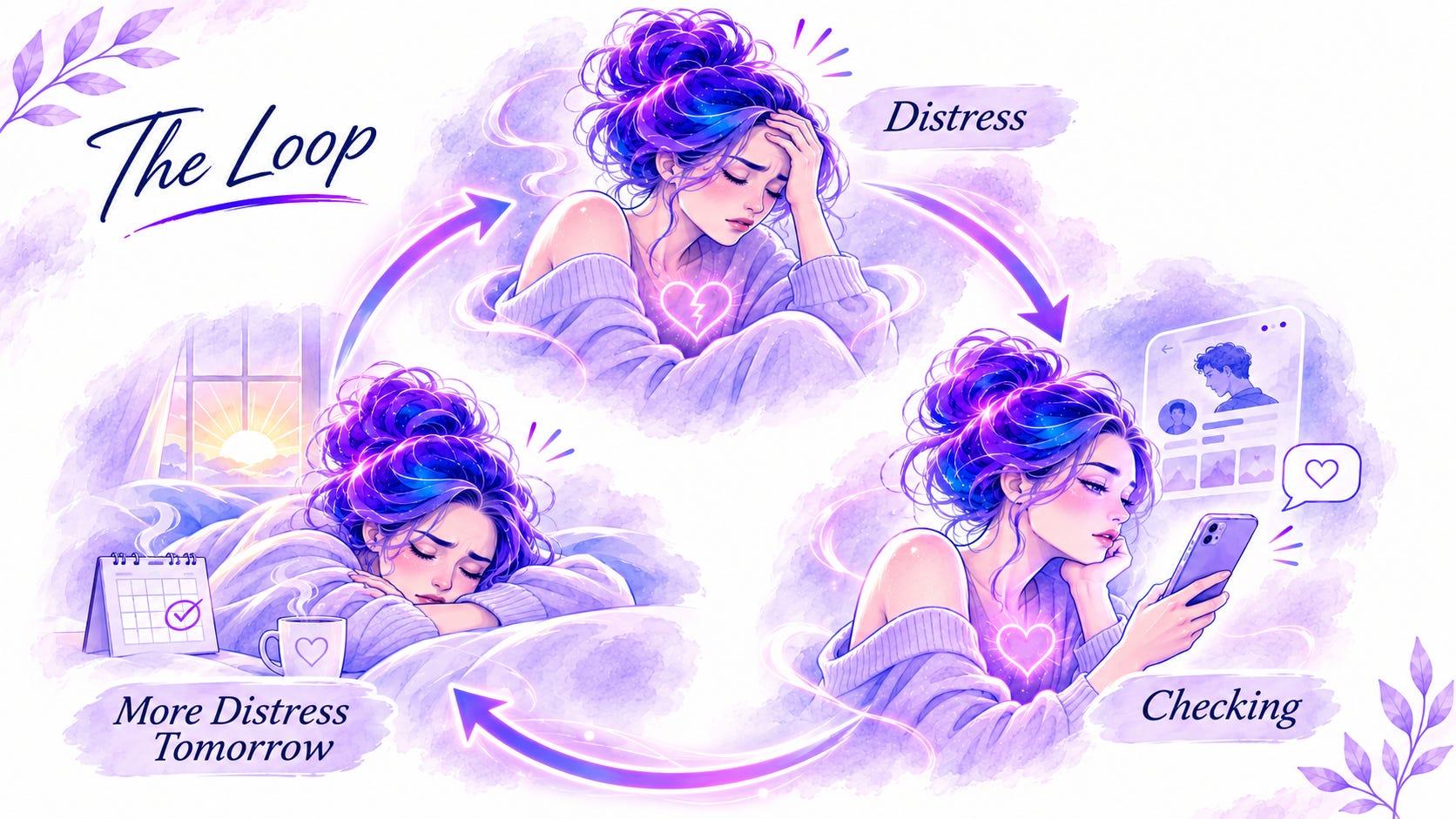
Meaning, this loop feeds itself… Yikes.
The Catch If You’re Anxiously Attached
I truly feel for the anxiously attached among us, because, sadly, if you’re anxiously attached, even the accidental sightings aren’t free…
Attachment anxiety changed the picture in two of the four studies Dr. Marshall ran.
In the six-month follow-up, the link between searching and breakup distress was stronger for people higher in attachment anxiety.
And in the ten-day diary study, highly anxious participants showed more jealousy after BOTH searching and passive sightings.
So if your attachment system runs hot, “I’ll stop searching but keep following him” probably isn’t gonna cut it.
And this makes total sense considering an anxious system’s whole job is monitoring.
Scanning for signs the connection is still there, or that it’s slipping.
Attachment researchers call this “hyperactivation.”
It’s not a character flaw. It’s a system that learned, a long time ago, that if it stopped watching, it’d get left.
So when you check his profile, that’s not you being pathetic.
That’s a Part of you doing exactly what it was trained to do… Try to get you certainty so it can finally relax.
The problem is certainty isn’t on his page.
It never was.
The Part of you that checks isn’t trying to hurt you.
It’s trying to get an answer his profile was never built to give.
So, what can you do instead?
Glad you asked!
Exactly What to Do Instead
Alright, the fun part: ACTION.
It’s simpler than you think too.
1. Kill the Searches First
You had to see this one coming…
Before you do anything else, you’ve gotta stop the deliberate searches.
Not the feed. Not the muting. The searches.
Why this first? Because that’s the one with the next-day bill attached.
If you only change one thing, change the one that costs you twice!
That includes ALL the side doors (Yes, I know about those too!):
His name in the search bar
His friends’ and family’s profiles
Her profile (yes, her)
Refreshing to see if he viewed your story
The burner account (ma’am, please delete the burner account lol)

2. Mute Him (Especially If You’re Anxious)
If you know your attachment system runs anxious, take the passive sightings off the table too.
I’m not even anxiously attached, but I did this one as well.
And you don’t gotta do the big dramatic block if that doesn’t feel right; I muted my ex and her friends, and then eventually unfollowed her.
Dr. Marshall herself recommends muting, unfollowing, or even taking a short break from social media altogether.
Muting is quiet; nobody gets notified, and his face stops ambushing you between a recipe video and a Pilates reel.
Oh, and btw, you should know, the algorithm may still slip him in now and then.
There’s even research on this delightful quirk of modern social media algorithms that showed people still ran into their exes after unfriending or blocking through mutual friends’ comments, “people you may know,” or old memories resurfacing.
So a random sighting after you’ve muted him isn’t a failure. It’s just the internet being the internet; just a friendly heads-up!
3. Name the Question Before You Open the App
When the urge hits, don’t fight it yet.
Just finish this sentence first, in your notes app or out loud: “I’m hoping his profile tells me ________.”

Then ask: can a curated feed actually answer that?
It can’t tell you if he misses you. It can’t tell you if he’s sorry. It definitely can’t tell you whether you were the problem.
Writing the question down pulls it out of the itch and into the part of you that can actually look at it.
A question you can see is a lot easier to put down than one you can only feel.
Ask me how I know that one…
4. Run Your Own Two-Day Experiment
For the next week, two quick notes every night before bed:
Did I go looking today? Yes or no.
How heavy does the breakup feel right now, 1 to 10?
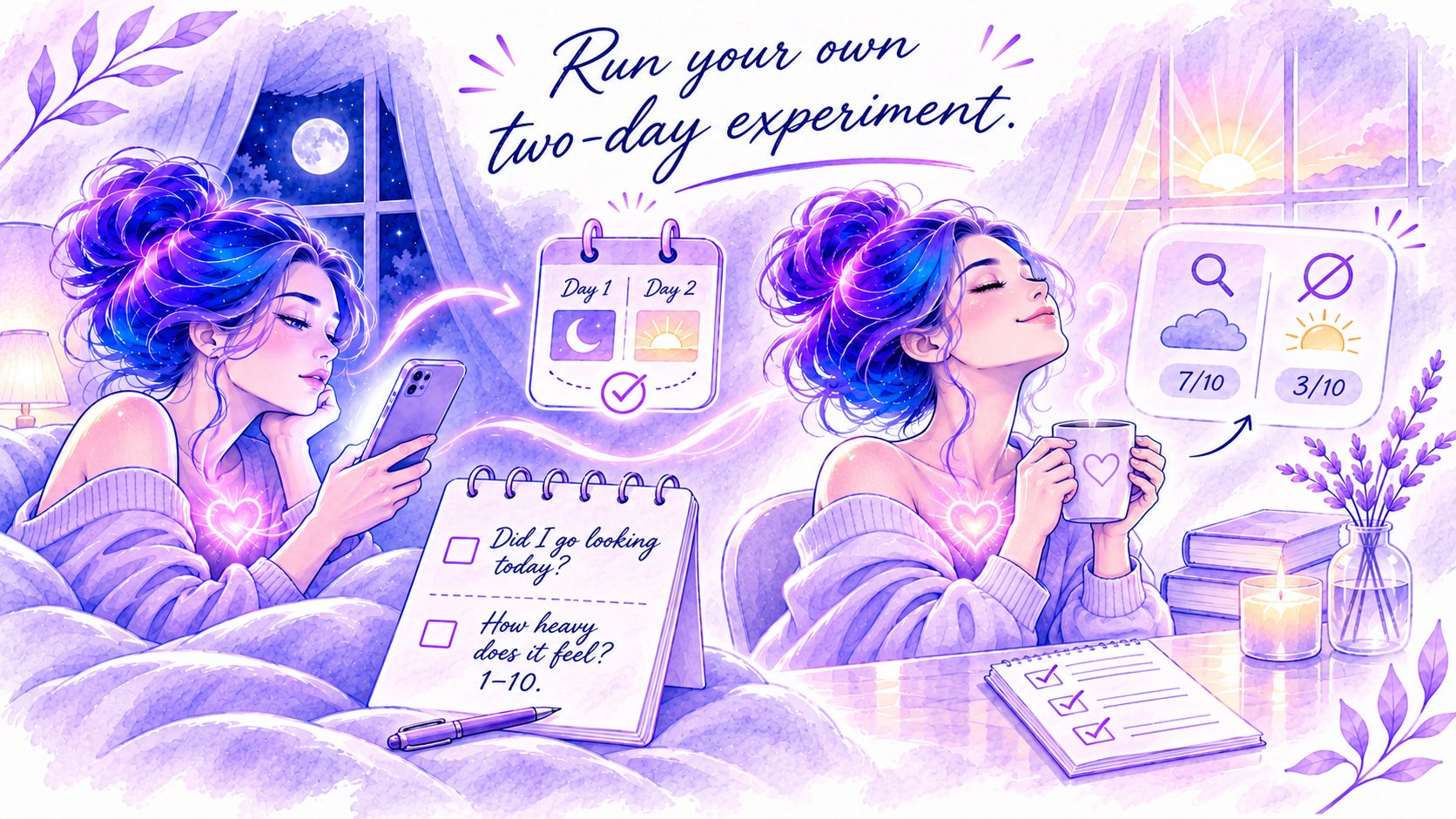
Then compare the mornings after search days to the mornings after no-search days.
My bet is you’ll see the pattern within a few days.
And once you’ve watched the tax hit your own account, it gets a LOT easier to stop paying it.
Awareness is always the first step in any change!
5. Have Your “Instead” Ready BEFORE the Urge Shows Up
Willpower at 11pm is NOT a strategy, lol.
Decide now what you’ll do when the urge hits, and make it specific:
“If I reach for his profile, I text my sister instead.”
“If I open Instagram in bed, the phone goes across the room, and I read ten pages.”
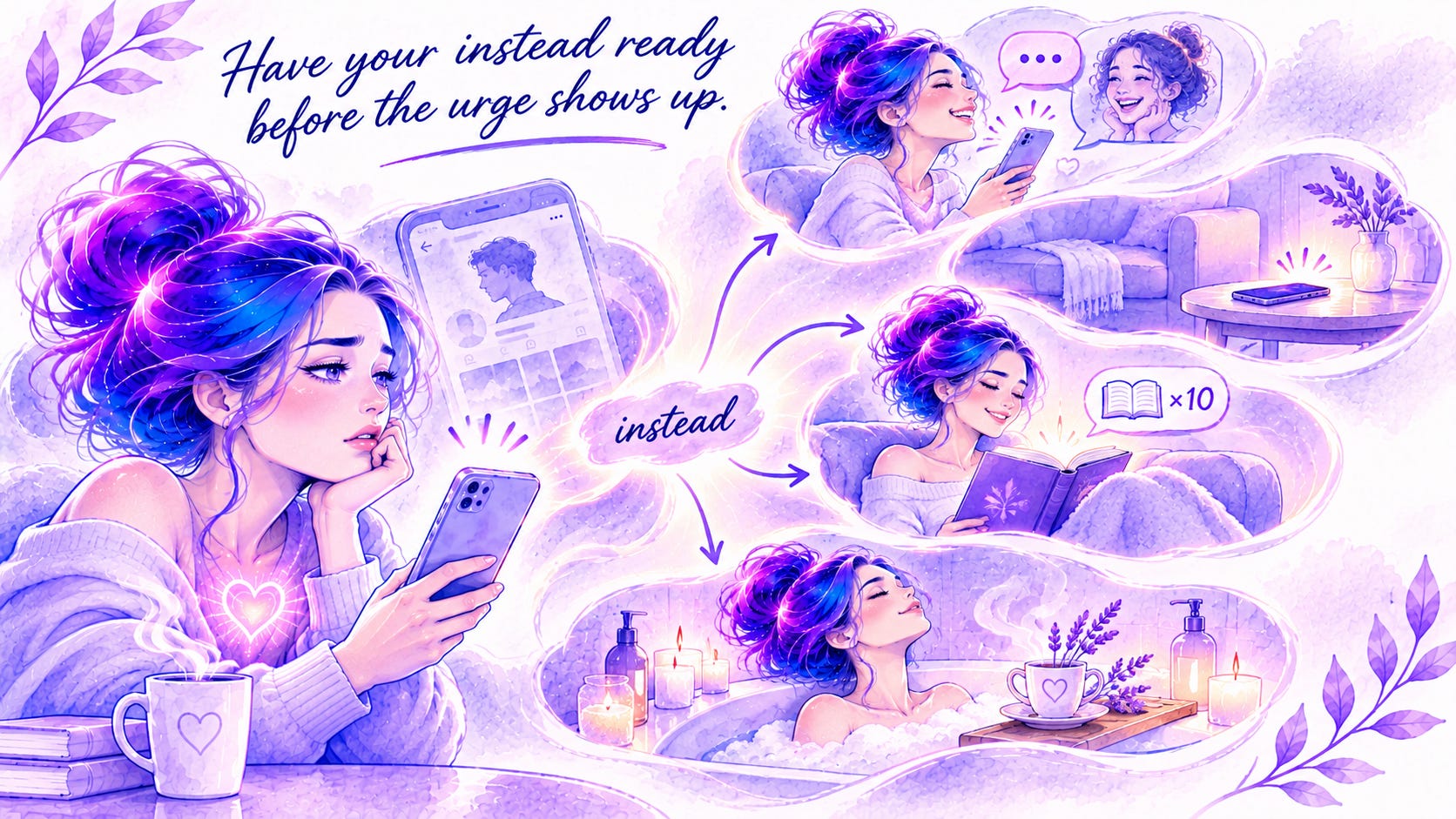
These if-then plans (researchers call them implementation intentions) have strong evidence behind them for actually following through on goals, because the decision is already made before the craving gets a vote.
Marshall also points to distraction as a useful tool, especially in the first few months when everything’s rawest.
My personal distraction included watching the entire Marvel Infinity Saga!
Distraction gets a bad rap in healing circles.
But in the early weeks, I call it triage, and not something you should feel bad about, so long as it doesn’t overstay its welcome!
The Answer Was Never on His Page
You thought the checking was keeping you informed. Close enough to know when it was finally safe to let go.
It was doing the opposite.
Every search kept the question open one more day, and an open question is the one thing your nervous system can’t rest on.
I learned this one the hard way.

The closure I wanted from my ex was never coming, and the moment I stopped waiting for it, I could finally start building it inside myself.
So tonight, the only thing you have to do is not type his name.
Then do it again tomorrow.
Whatever you’re hoping to find on his page, you’ll find faster by closing it.
You’ve got this.
And as always, until next time… Live Heroically 🧠
Wrecked to Regulated in 63 Days
Start Here: She Rises Community.
Inside is a 63-day program of the exact things I did myself to go from wrecked to regulated using neuroscience.
Plus, You’ll Have Access To:
A 63-day program to go from wrecked to regulated
Live coaching calls with me every week
A team of IFS practitioners
Private workshops and masterclasses with therapists and scientists
1-on-1 sessions
A room full of women doing this beside you
If you’re ready to become emotionally available, develop secure attachment, and attract healthy potential partners, this is for you!
The first 7 days are free. Join below!
Leave a Comment
Do you still follow your ex on social media? Why or why not?
Supporting Research
Marshall, T. C. (2026). Social media observation of ex-partners is associated with greater breakup distress, negative affect, and jealousy. Computers in Human Behavior, 176. [Article number and DOI to confirm]
Marshall, T. C. (2012). Facebook surveillance of former romantic partners: Associations with postbreakup recovery and personal growth. Cyberpsychology, Behavior, and Social Networking, 15(10), 521–526. https://doi.org/10.1089/cyber.2012.0125
Fox, J., & Tokunaga, R. S. (2015). Romantic partner monitoring after breakups: Attachment, dependence, distress, and post-dissolution online surveillance via social networking sites. Cyberpsychology, Behavior, and Social Networking, 18(9), 491–498.
Pinter, A. T., Jiang, J. A., Gach, K. Z., Sidwell, M. M., Dykes, J. E., & Brubaker, J. R. (2019). “Am I never going to be free of all this crap?” Upsetting encounters with algorithmically curated content about ex-partners. Proceedings of the ACM on Human-Computer Interaction, 3(CSCW), Article 70. https://doi.org/10.1145/3359172
Mikulincer, M., & Shaver, P. R. (2016). Attachment in adulthood: Structure, dynamics, and change (2nd ed.). Guilford Press.
Fisher, H. E., Brown, L. L., Aron, A., Strong, G., & Mashek, D. (2010). Reward, addiction, and emotion regulation systems associated with rejection in love. Journal of Neurophysiology, 104(1), 51–60.
Nolen-Hoeksema, S., Wisco, B. E., & Lyubomirsky, S. (2008). Rethinking rumination. Perspectives on Psychological Science, 3(5), 400–424.
Gollwitzer, P. M., & Sheeran, P. (2006). Implementation intentions and goal achievement: A meta-analysis of effects and processes. Advances in Experimental Social Psychology, 38, 69–119.
This article is educational in nature and not a substitute for therapy. If attachment wounds or relational trauma are impacting your well-being, working with a trauma therapist can help your nervous system relearn safety in connection.