
The 3 Dating Types Post Heartbreak 🧠
Which Type of Stuck Are You? (And How to Actually Get Out)

TL;DR Summary:
After real heartbreak, the nervous system doesn’t just heal on its own — it adapts. And those adaptations tend to collapse into three recognizable types.
Type 1 (Heartbreak-to-Hermit): Her life looks great. It’s also airtight. She calls it healing. Her nervous system calls it armor.
Type 2 (Dating With Fear): She’s out there — but she’s dating from a dysregulated nervous system that can’t tell the difference between chemistry and chaos.
Type 3 (Jaded Observer): She’s not heartbroken anymore. She’s done. But cynicism isn’t clarity — it’s unprocessed grief with a good poker face.
All three share the same root: the last chapter never fully closed.
The fourth type — HER — isn’t a fantasy. She’s what you build when you do the actual work.
Becoming HER starts with two things: defining who she is, and learning to process your emotional world from the inside out — not the outside in.
Which Type of Stuck Are You?
I’ve worked with hundreds of women, for thousands of hours, navigating modern dating after heartbreak, and almost every single one falls into one of three types.
Not because women are predictable.
Because the nervous system is.
When we experience a real attachment rupture, not just disappointment, but the kind of heartbreak that genuinely reorganizes our sense of safety in the world, the nervous system doesn’t just go back to baseline.

It adapts. It builds new rules. It starts filtering every future connection through the lens of: is this safe, or is this a threat?
And those adaptations look different depending on your history, your attachment style, and honestly, your personality.
But in my work, and in my own life, they tend to collapse into three very recognizable patterns.
So, which one are you?
Let’s find out!
Type 1: Heartbreak-to-Hermit
This type isn’t healing, she’s hiding.
She says things like: “I’m fine on my own.” “I just need more time.” “I’ll date again when I feel ready.”
On paper? She looks great.
Career is thriving. Gym routine is locked in. Friend group is solid. She’s reading, traveling, maybe even going to therapy, yay!

Everyone around her keeps saying she’s “doing so well.”
And she is, on the SURFACE.
But look closer, and you’ll notice something: her life has become airtight.
There’s no space. No openings. No cracks where someone new could actually get in.
If you think that’s an accident, you’d be sadly mistaken.
What’s Actually Happening Neurologically
Ight, let’s talk brains.
After a significant attachment rupture, the brain does something really interesting and really protective.
The amygdala, your brain’s threat-detection center, starts associating the vulnerability of connection with the pain of the rupture.
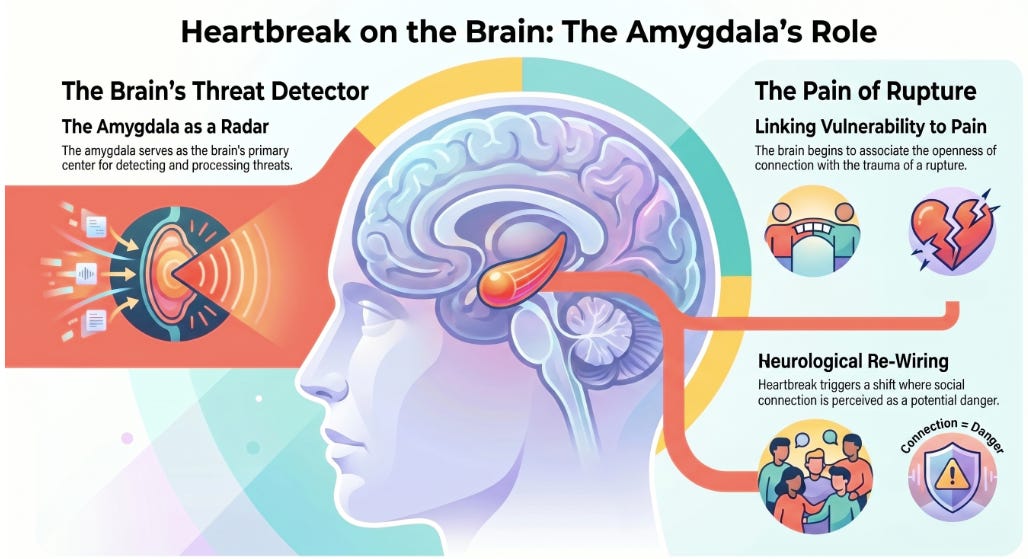
And because the nervous system is fundamentally a prediction machine, it begins working overtime to prevent that pain from happening again.
This can show up as avoidance, not the dramatic, obvious kind, but the subtle, sophisticated kind.
The kind that looks like independence. Like boundaries. Like I just know what I want now.
What’s actually happening is that her prefrontal cortex (the rational, planning brain) has been recruited by the nervous system to build a fortress and call it a lifestyle.
Gotta talk about cortisol here as well, because it rises in response to the anticipatory threat of vulnerability now.
And the nervous system, having learned that intimacy = pain, starts to orient away from anything that might reactivate that experience.
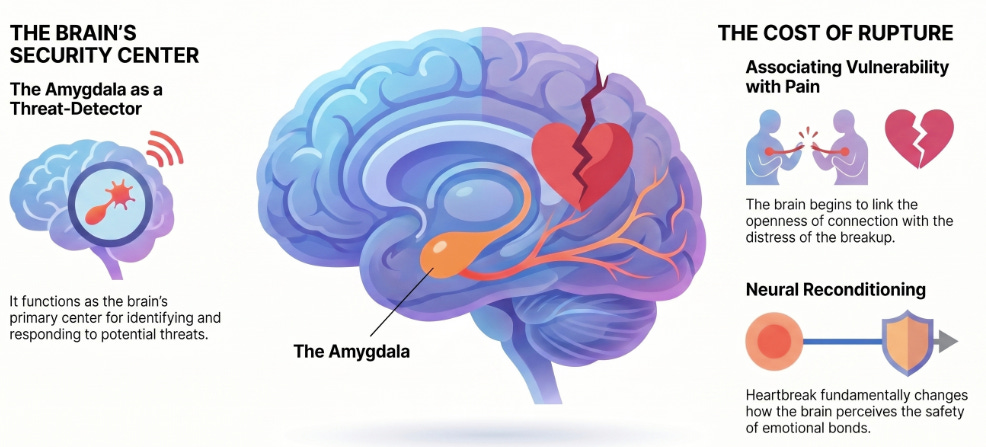
Busyness becomes a regulatory strategy. Fullness becomes armor.
The research on this is clear, hyperactivation of the threat-response system following attachment trauma doesn’t just make intimacy feel scary, it makes it feel unnecessary.
The dorsal vagal system can shift the person into a state of quiet shutdown that feels remarkably like peace.
It isn’t.
It’s a frozen, dissociated state with good aesthetics.
The Core Wound
One of the most common beliefs/wounds I find in this type is: “If I open up again, I’ll get destroyed again.”
Ask me how I know that one… Good ole lived experience, baby!
After my own breakup, a blindsiding, traumatic attachment rupture that I genuinely didn’t see coming, I found myself thinking exactly this.

This isn’t surprising, really, especially so close to the traumatic event.
It’s healthy even. You need time to process what just happened and heal.
The real issue is when this belief becomes your new operating system.
I know firsthand how scary and painful this one can be, but I can assure you, trying to live your life with this belief running in the background is far scarier and much lonelier.
Heartbreak is sometimes the tutution for wholeheartedness, unfortunately enough, peeps.
Learning from what happened to you and eventually coming to the realization that true love is worth the risk is a much better belief to carry forward.
More on how to actually do this in a moment.
Type 2: Dating With Fear
This type is out there, but she’s bracing for impact.
She says things like: “Why do I keep attracting the same person?” “I don’t trust myself not to repeat this.” “I’m trying, but something always goes wrong.”
She hasn’t retreated. She’s out there, swiping, going on dates, trying.

And she deserves real credit for that, because pushing yourself back into dating after you’ve been genuinely hurt takes courage.
Again, I’ve been there, and TRULY get it.
But here’s what’s happening underneath: she’s dating from a dysregulated nervous system.
And a dysregulated nervous system cannot accurately assess safety, let alone a healthy partner.
What’s Actually Happening Neurologically
Let’s go back to the brain real quick.
When we’ve experienced attachment trauma, the hippocampus, the brain’s memory and context center, starts to function in a particular way.
It begins pattern-matching. Fast.
The brain becomes hypervigilant for cues that this might be like last time, and it often finds them, because it’s looking for them.
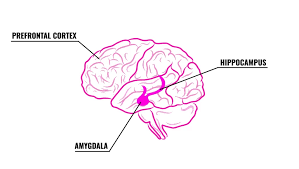
This is intermittent reinforcement meets predictive processing.
The nervous system that has been hurt before isn’t just cautious, it’s preemptively activating.
Which means the anxiety, the hypervigilance, the obsessive analysis of texts, none of that is irrational.
It’s your nervous system doing exactly what it was designed to do after an attachment wound.
The problem is that the signals get scrambled.
Cortisol and norepinephrine, the neurochemicals of stress and alertness, can literally feel like excitement.
The racing heart, the obsessive thinking, the electric quality of an anxious connection?
That cocktail of stress hormones can be indistinguishable from what we’ve been taught to call chemistry.
Especially if what we grew up experiencing as “love” was actually anxious attunement to an inconsistent caregiver.
So she ends up gravitating toward the familiar, which isn’t the same as healthy.
She mistakes intensity for depth. Anxiety for attraction. She moves fast and then wonders why she always ends up here.

And then the self-blame spiral begins: I pick the wrong people. I don’t trust my judgment. What’s wrong with me?
It’s a nasty little cycle.
The Core Wound
The most common wound I find in this type is: “I don’t trust my own judgment anymore.”
Nothing erodes self-trust faster than repeatedly ending up hurt despite genuinely trying not to be.
And when you can’t trust your nervous system to tell you what’s safe, dating becomes an exercise in second-guessing everything, which is exhausting, and doesn’t actually make you safer.
The issue isn’t her judgment.
It’s that her nervous system needs recalibration before judgment can be reliable.

You can’t accurately assess a new person while you’re running them through the filter of an unprocessed old one.
Again, more on solving this shortly, we’ve got one more type to cover first, though!
Type 3: Jaded Observer
This type of woman isn’t heartbroken anymore… She’s just done.
She says things like: “Good men don’t exist.” “Modern dating is broken.” “It’s just not worth the emotional labor.”
She’s not crying over anyone. She’s not anxious about dating. She’s just... checked out.
And honestly? Part of her is proud of it. She’s done being naive.
She’s done giving her best to people who didn’t deserve it.
And I want to be careful here, because sometimes this woman is genuinely in a season of intentional rest, and that’s not what I’m talking about.

If the detachment comes with bitterness?
If the “clarity” about men or dating comes with a low-grade contempt?
That’s not wisdom.
That’s an unprocessed heartbreak wearing a leather jacket.
Sorry, not sorry 😬
What’s Actually Happening Neurologically
Alright, back into the brain one more time!
This one is interesting because cynicism is a form of preemptive grief.
When the nervous system has been hurt enough times or hurt badly enough once, the dorsal vagal branch of the autonomic nervous system can shift into a state of adaptive shutdown.
This isn’t dramatic. It doesn’t feel like a shutdown.
It feels like realism. Like clarity. Like finally having the scales lifted from your eyes.
But what’s actually happening is that the nervous system has concluded that hope is too costly.
Because hope requires vulnerability, and vulnerability has a track record of producing pain.

So the system shuts down access to hope, not as a decision, but as a protection.
There’s also a phenomenon here called learned helplessness, which is a neurological state in which repeated painful outcomes produce a generalized belief that outcomes can’t be changed.
It was originally described by Martin Seligman in animals, but the human parallel is well-established.
When we keep trying and keep getting hurt, the brain sometimes concludes that trying is the problem.
So she stops trying… And calls it growth.
The Core Wound
The wound I see in this type shouldn’t be surprising to anyone, it’s: “Love costs too much, and I always pay the highest price.”
Or something synonymous with this.
This one’s the most important to name honestly, because the jadedness feels so justified.
And in some ways, it is, she probably has genuinely given more than she received.
She probably has been the one who loved harder, stayed longer, and tried more.

That’s real, I’ve also been here, and stared down the slippery slope of becoming jaded about it all.
The core issue around this belief is the conclusion she’s drawn, that this is just the nature of love, which isn’t accurate.
It’s the nervous system overgeneralizing from a wound.
The past isn’t a reliable guide to the future in this case.
Three Types, One Root Cause
These three types look completely different on the outside.
One is withdrawn. One is out there trying. One has given up entirely.
But they share an eerily similar root.
The last chapter never fully closed.
Not because these women are broken, weak, or doing it wrong.
But because no one taught them that the gap between relationships is the most important work they’ll ever do, and that it requires more than time, distraction, or a new gym routine.

The kind of wounds that lead to these 3 types don’t heal by default.
They heal through active, structured, informed work.
And the version of you that’s ready for a healthy relationship isn’t found by dating more or waiting longer…
It’s built.
Here’s how to start building!
Type Four: HER
In my work with clients, I call the fourth type a HER.
This is the neurologically regulated, emotionally resourced, clearly boundaried version of you that exists on the other side of doing this work properly.
It’s an aspirational future version of yourself that you create yourself!

I’ve helped build a ton of these, so here are some of the common patterns I see in these HER’s!
She’s learned how to truly love herself, so when someone outside of her chooses her, it’s a bonus, not a lifeline.
She has an internal compass that helps her navigate dating with discernment, not just hope.
She asks for what she needs. She knows how to actually receive it.
She can feel chemistry without losing herself in it.
She knows the difference between familiar and healthy. And she chooses healthy.
She is magnetic and intoxicating to healthy men.
Obviously, this isn’t all-encompassing; your HER is yours.
Every time I create one of these with someone, it’s completely unique to them, as it should be!
What’s happening in her nervous system
Now, let’s take a lil peek-a-boo into the brain and nervous system of a HER.
Her new baseline state is a ventral vagal state, meaning she’s regulated, connected, and genuinely available for intimacy without being destabilized by it.
She has a framework for discernment, not just intuition, so she knows what she’s looking for and why.
She’s recalibrated her neurochemistry so that “tonic” dopamine (the stable, slow-burn reward of a consistent connection) feels more compelling than “phasic” dopamine (the spike-and-crash of anxious intensity).
Her amygdala isn’t running the show anymore.
She truly believes: “She’s not waiting to be chosen. She chooses.” “She’s not starting over. She’s starting from a completely different place.” “Heartbreak didn’t break HER. It just showed HER what still needed to heal.”
She stopped being a woman who things happen to.
She became a woman who makes them happen.
It’s an inspiring transformation I’ve seen so many women make, and right about now you’re probably wondering, “How on earth do I do this, Cody?!”
Great question, you know I got you.
How You Actually Become HER
Ok, let’s get practical.
Because the three types above? They’re a diagnosis.
And diagnoses are only useful if they point somewhere.
Here’s what I’ve found, through my own process and through working with hundreds of women, is the actual path out.
These steps come directly from my 63 Day Becoming HER Program.
Obviously, I can’t cover a full program in one blog, but here are the first 2 steps!
Step 1: Define HER
You cannot build toward something you can’t see.
And most women trying to heal from heartbreak are doing it reactively, moving away from pain, not toward something specific.
This does NOT work, trust me, I’ve tried…
That’s why the first step for every single woman who goes through Becoming HER is to create a clear, grounded, neurologically honest vision of the woman you are becoming.

Not a fantasy. Not a highlight reel. A real picture of who you are when you’re regulated, boundaried, and genuinely available for the love you want.
This is different from writing down qualities you want in a partner. This is about who you need to become to both attract and sustain that kind of relationship.
These are two very different things.
What does she believe about herself? What does she do when she’s scared? How does she respond to inconsistency? What does she require, and what does she walk away from without a second thought?
When HER is defined, every decision you make in the healing process has a compass.
This is what gives the work direction instead of just depth.
Once you have your HER, the real magic begins, because you can start to ask the ONE Thing question:
“What’s ONE Thing I can do today, to get closer to becoming HER?”
Women in my Becoming HER program ask this daily, and are held accountable for DOING the things this question generates.
This makes becoming HER… INEVITABLE.
Step 2: Learn to Process Inside-Out (Not Outside-In)
Next up is probably the biggest mindset transformation of the entire program.
It changes everything.
Most of us have been processing our emotional world from the outside in since we were kids.
Which makes sense, kids need to do this because they’re helpless for a long period of their early life.

However, you’re not a kid anymore, yet you date and love like one because no one teaches us how to shift into an Inside-Out as we grow up.
So you end up waiting for circumstances to change so you can feel better. Waiting for him to text back, to explain, to apologize, to come back, to choose you. Waiting to feel okay until the external situation resolves.
That’s outside-in processing at its finest.
And it’s a trap, because it hands your nervous system regulation and agency to someone who has already demonstrated they can’t be trusted with it.
Inside-out processing means learning to regulate and resource yourself regardless of what’s happening externally.
It means your nervous system isn’t tethered to someone else’s behavior.
Neurologically, this is the shift from external co-regulation (relying on others to help your nervous system settle) to self-regulation.
And not in the toxic-independence way, but in the genuinely sovereign way.
Your window of tolerance expands. Your threat-response system becomes less reactive. You can stay present in difficult conversations without flooding or shutting down.
This is the difference between a woman who dates because she needs connection and a woman who dates because she wants it.
At the end of Becoming HER, this is the exact mindset women have developed, and it’s beautiful to witness.
Becoming HER
As I mentioned earlier, I can’t cover a full 9-week program in one blog, but these are the first two steps every woman takes inside my program Becoming HER.
It’s a structured, neuroscience-informed, IFS-grounded process designed specifically for high-achieving women who are ready to stop cycling through the same patterns and start building something new from the inside out.
If this is something you’re interested in, we have a few spots left in our next cohort.
I’ll add a button below for you to apply.
Let me be clear, this isn’t another self-help course; it’s hard work.
But at the end, you’ll have a structured operating system for becoming the woman who doesn’t just attract healthy love…
She recognizes it, chooses it, and keeps it.
You’re Not Stuck Because You’re Broken
You’re stuck because you’ve been doing the thing that made sense, surviving. Protecting yourself. Managing the damage.
And that part of you? She’s not the problem.
She’s proof that you knew how to take care of yourself when you didn’t have better tools.
But you have better tools now. Or you’re about to.
On the other side of this work, love stops feeling like something to survive and starts feeling like something you can actually receive.
Dating stops feeling like a test you keep failing and starts feeling like a discovery you’re equipped for.
You’re not starting over.
You’re starting from a completely different place.
You’ve got this.
And until next time… Live Heroically 🧠
Want to Work With Me? Here Are a Few Ways I Can Help You
Becoming HER is a 63-Day program that heals heartbreak & prepares you for modern dating, using Neuroscience & Internal Family Systems. (If you’re seeing this, one of our cohorts is open currently!)
Going through a breakup? Check out She Rises. It’s a post-breakup protocol based on neuroscience to help you regulate your nervous system in the days and weeks right after a breakup.
Grab my new ebook: Exactly How to Become Emotionally Available: It’s a step-by-step guide for attracting and keeping the love you seek, built for the success but single among us!
Become a paid subscriber to the Mind, Brain, Body Lab Digest: You’ll get subscriber-only posts, email replies, access to my entire blog archive, early access to new products, workshops & tools I create!
Supporting Research
Attachment, Heartbreak & Nervous System Reorganization
Bowlby, J. (1969). Attachment and loss: Vol. 1. Attachment. Basic Books.
Mikulincer, M., & Shaver, P. R. (2007). Attachment in adulthood: Structure, dynamics, and change. Guilford Press.
Sbarra, D. A., & Hazan, C. (2008). Coregulation, dysregulation, self-regulation: An integrative analysis and empirical agenda for understanding adult attachment, separation, loss, and recovery. Personality and Social Psychology Review, 12(2), 141–167.
Fisher, H. E., Brown, L. L., Aron, A., Strong, G., & Mashek, D. (2010). Reward, addiction, and emotion regulation systems associated with rejection in love. Journal of Neurophysiology, 104(1), 51–60.
Predictive Processing, Threat Response & Avoidance
Clark, A. (2016). Surfing uncertainty: Prediction, action, and the embodied mind. Oxford University Press.
LeDoux, J. E. (2015). Anxious: Using the brain to understand and treat fear and anxiety. Viking.
Porges, S. W. (2011). The polyvagal theory: Neurophysiological foundations of emotions, attachment, communication, and self-regulation. Norton.
Neurochemistry of Attachment & Intimacy
Insel, T. R. (1997). A neurobiological basis of social attachment. American Journal of Psychiatry, 154(6), 726–735.
Young, L. J., & Wang, Z. (2004). The neurobiology of pair bonding. Nature Neuroscience, 7(10), 1048–1054.
Depue, R. A., & Morrone-Strupinsky, J. V. (2005). A neurobehavioral model of affiliative bonding. Behavioral and Brain Sciences, 28(3), 313–350.
Learned Helplessness & Generalization of Threat
Seligman, M. E. P. (1975). Helplessness: On depression, development, and death. Freeman.
Maier, S. F., & Seligman, M. E. P. (2016). Learned helplessness at fifty: Insights from neuroscience. Psychological Review, 123(4), 349–367.
IFS, Parts, & Neuroplasticity
Schwartz, R. C. (1995). Internal family systems therapy. Guilford Press.
Schwartz, R. C., & Sweezy, M. (2020). Internal family systems therapy (2nd ed.). Guilford Press.
Ecker, B., Ticic, R., & Hulley, L. (2012). Unlocking the emotional brain: Eliminating symptoms at their roots using memory reconsolidation. Routledge.
Siegel, D. J. (2010). Mindsight: The new science of personal transformation. Bantam Books.
This article is educational in nature and not a substitute for therapy. If attachment wounds or relational trauma are impacting your well-being, working with a trauma-informed therapist can help your nervous system relearn safety in connection.