
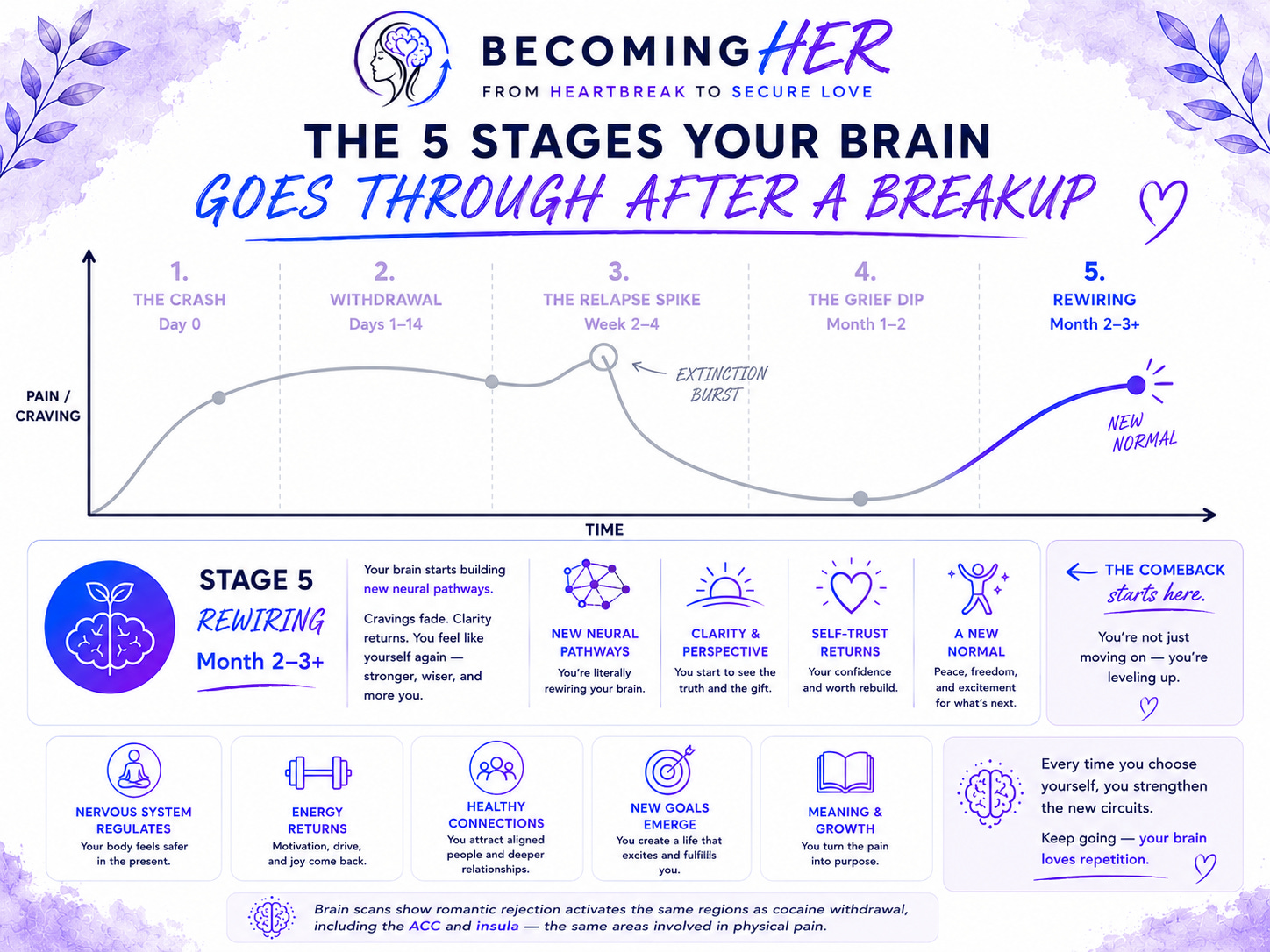
The 5 Stages Your Brain Goes Through After a Breakup 🧠
It’s not chaos. It’s a curve. And every stage has its own job for you.

TL;DR Summary:
What feels like random emotional weather is actually a sequence. Five stages, in order, each with its own chemistry, its own thoughts, and its own trap.
You can’t use the same tools in every stage. The thing that saves you in week one will actively hurt you in month two — which is why so much breakup advice fails you at exactly the wrong moment.
Stage three is where almost everyone breaks. It’s also the stage that means it’s working. I’ll explain why the surge is good news.
The stage nobody warns you about isn’t the crash. It’s the quiet one around month two that feels like the healing stopped working.
Every stage is chemical, predictable, and mapped. Not a single one of them is a character flaw.
And there’s one 30-second move that works in every stage. It’s not deep breathing. It’s not journaling. It’s at the end.
What’s the Worst Part of Heartbreak?
It’s not the pain.
It’s that the pain doesn’t make any sense.
One week, you can’t stop crying. The next week, you feel almost fine, and you wonder if you ever really loved him.
Then out of nowhere, it’s 2am and you’re spiraling harder than day one, and you think, wait, I already did this part.
Then a month later, you feel nothing at all, which somehow scares you more than the crying did.

So you start diagnosing yourself. I’m going backwards. I’m broken. Something’s wrong with me.
Everyone else moves on, and I’m still here.
You’re not going backwards.
You’re moving through five distinct neurological stages, in order, and each one feels completely different from the last, which is exactly why it feels like chaos from the inside.
From the inside, it’s weather. From the outside, it’s a curve.
Predictable enough that once someone shows you the shape of it, you can look at any given Tuesday and know: oh. This is stage three. This is supposed to happen right now. This is what I do here.
You can’t calm down what you can’t name. And you can’t name what nobody ever mapped for you.
So let’s map it.
Five stages, what’s happening in your brain and body inside each one, and a mini-protocol of what to actually do while you’re in it.
You’ll notice the tools change from stage to stage; that’s on purpose, I promise, and that’s the part almost everyone gets wrong.
Let’s dive in!
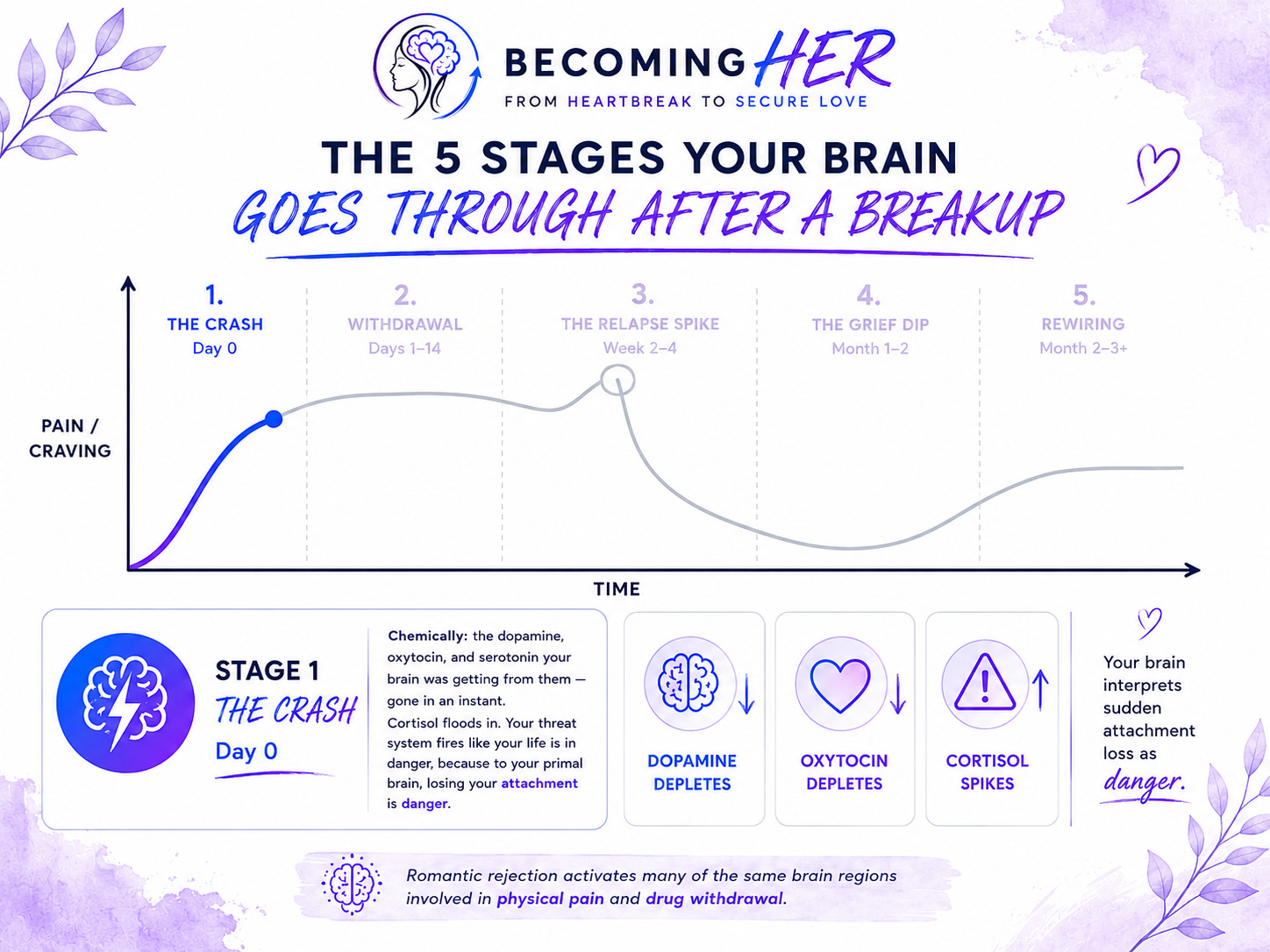
Stage 1: The Crash, Day 0
What’s Happening in the Brain
For however long you were with him, your nervous system had a supply line.
A specific voice, smell, body, and rhythm of contact were delivering a daily chemical mix.
Dopamine for anticipation, oxytocin for bonding, opioids for the warm hit of being held, serotonin for baseline stability.
That line got cut. No taper. In one conversation.
Cortisol and norepinephrine flood the space it left, and your threat system fires like your physical life is in danger, because to the oldest parts of your brain, losing an attachment figure IS a survival event.

For most of human history, being cut off from your person meant you might not make it through winter.
And two of the regions doing the loudest work right now, the anterior cingulate cortex and the insula, are involved in processing physical pain as well as social rejection.
So when you say “it hurts,” you’re not being poetic. Your body is running an injury program without an injury.
What It Looks & Feels Like
You can’t eat. Or you can’t stop. Sleep won’t come, or it comes in 90-minute chunks that end with you awake at 4am with your heart already racing.
You check your phone every ninety seconds with no plan for what you’d do if it buzzed. Hands shaking. Chest like a fist.
It sounds like: “This can’t be real. I can’t breathe. This isn’t happening.”
Important note here… This is NOT the stage for insight.
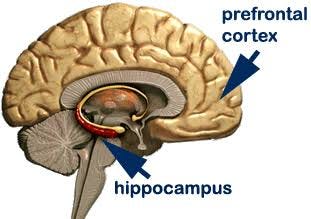
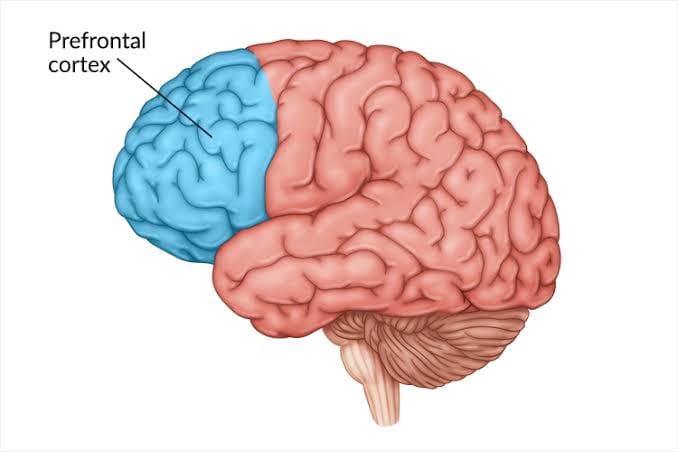
Your prefrontal cortex, the reflective, make-meaning-of-this part of your brain, is essentially offline under this much arousal.
Anyone handing you a journaling prompt right now means well and does not understand the assignment.
Mini-Protocol: Stage 1
1. Drop the standard to survival. Water. Protein twice a day even if it’s disgusting. Horizontal in a dark room for eight hours even if you don’t sleep. That’s the whole to-do list. You are not healing today. You’re stabilizing.
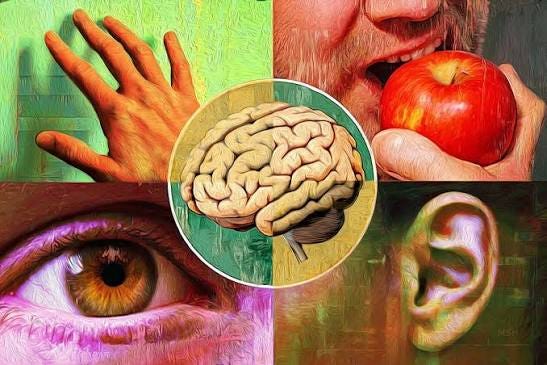
2. Orient before you analyze. When panic hits: feet on the floor, slowly turn your head, name five things you can actually see. Not a cute mindfulness trick, slow visual orienting tells your brainstem there’s no predator in the room, which starts walking you down out of full sympathetic activation. Repeat as needed.
3. Tell one human tonight. Not a group chat. One person, out loud, voice to voice. Co-regulation is the only input that reliably works when your own regulation is this offline. You borrow someone else’s calm until yours comes back online.
Bottom line: Stage 1 isn’t a problem to solve. It’s a wound to stay alive through.
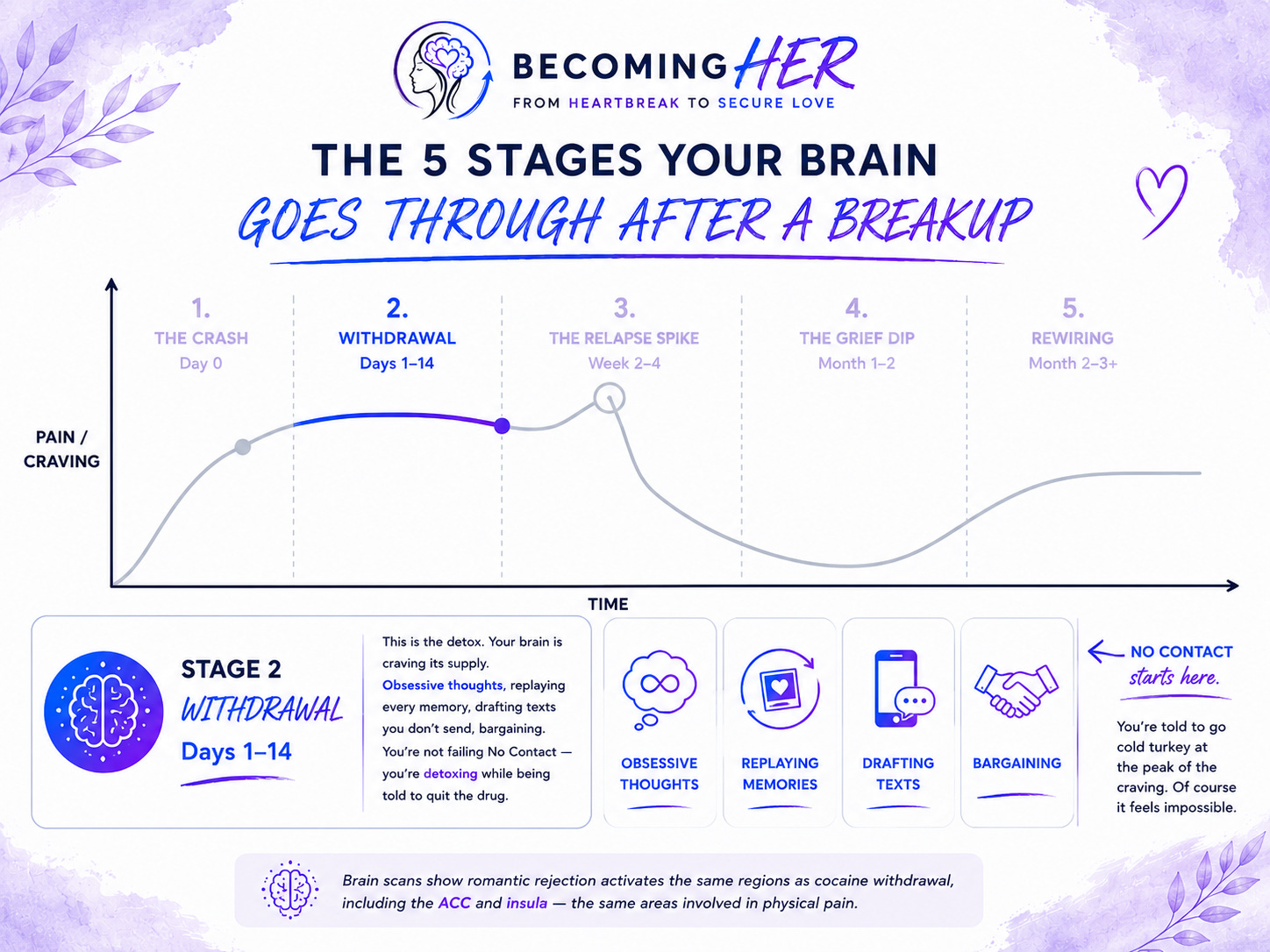
Stage 2: Withdrawal, Days 1–14
What’s Happening in the Brain
When researchers put recently rejected people in a scanner and showed them photos of the person who left, the regions that lit up weren’t the “sad” parts of the brain.
They were the reward and motivation circuitry, the same system that drives craving in substance withdrawal.
Which is why this stage doesn’t feel like sadness. It feels like need.
Your reward system hasn’t accepted the news yet. It’s still running the old prediction: contact with this person equals relief.
So every time you feel bad, it proposes the same fix it’s proposed for months: reach for them.

And because that reaching became a habit, it’s not stored as a decision anymore.
Habits migrate into the dorsal striatum, the same machinery that drives you home on autopilot.
Which is why you’ll find yourself with your phone in your hand and no memory of unlocking it.
That’s not a weakness of character. That’s motor memory. Your thumb knows the route.
Two other things are stacked against you here.
First, your memory system is not giving you a balanced highlight reel, the amygdala tags emotionally charged experiences as high-priority, so what surfaces is the good stuff in 4K while the reasons you’re here get compressed into a footnote.
Second, cue-induced craving is running the show.
A song. His street. Sunday at 6pm. Each one produces a real surge in your reward circuitry before you have a conscious thought about him at all.
What It Looks & Feels Like
Obsessive replaying. Court cases in your head that you win beautifully and he never hears. Drafting texts and deleting them.
Reading old messages like there’s evidence hidden in them you missed the first eleven times.
It sounds like: “Maybe just one conversation. For closure.”
I did this one myself.
Texted her about a month after and asked if she’d talk it through so I could process it.

She said no… That it wouldn’t serve her healing.
And that no landed like a second rupture stacked on the first.
I don’t recommend the experiment…
I completely understand why you want to run it, though.
Let’s Talk About No Contact :)
Notice the timing.
This stage, days 1 through 14, peak craving, habit machinery in full control, prefrontal cortex at its weakest, is exactly when you’re told to go cold turkey and never speak to him again.
That’s the hardest possible moment, neurologically, to attempt abstinence from anything.
No Contact isn’t wrong. The framing is.
It’s not a test of your character that you pass or fail; it’s cue management during a detox.
And when you treat it that way, you stop white-knuckling and start engineering.
Mini-Protocol: Stage 2
1. Change the cues before you test the willpower. People, places, things. Mute rather than dramatically block; it’s less charged, just as effective. Archive the photos somewhere you can’t stumble into. Take the other route to work. I changed gyms. It felt ridiculous, and it was one of the most effective things I did, because a cue you never encounter is a craving you never have to fight.
2. Use the 20-minute rule instead of the never rule. “I’ll never text him” is a promise your prefrontal cortex makes on a good day and can’t keep on a bad one. “I’m not texting him for the next 20 minutes” is a promise you can actually keep, and cravings are waves, not plateaus. Most crest and fall inside that window. Then you make the promise again.
3. Write the text. Send it nowhere. (I’ve used this one myself 100 times) Open a note and say the whole thing, the ugly parts, the begging parts, the parts you’d be embarrassed by. The urge is largely an urge to discharge, and discharge doesn’t require a recipient. This is the front door of self-closure, and I’ll be blunt: it’s the only closure most people ever actually get.
Stage 3: The Relapse Spike, Weeks 2–4
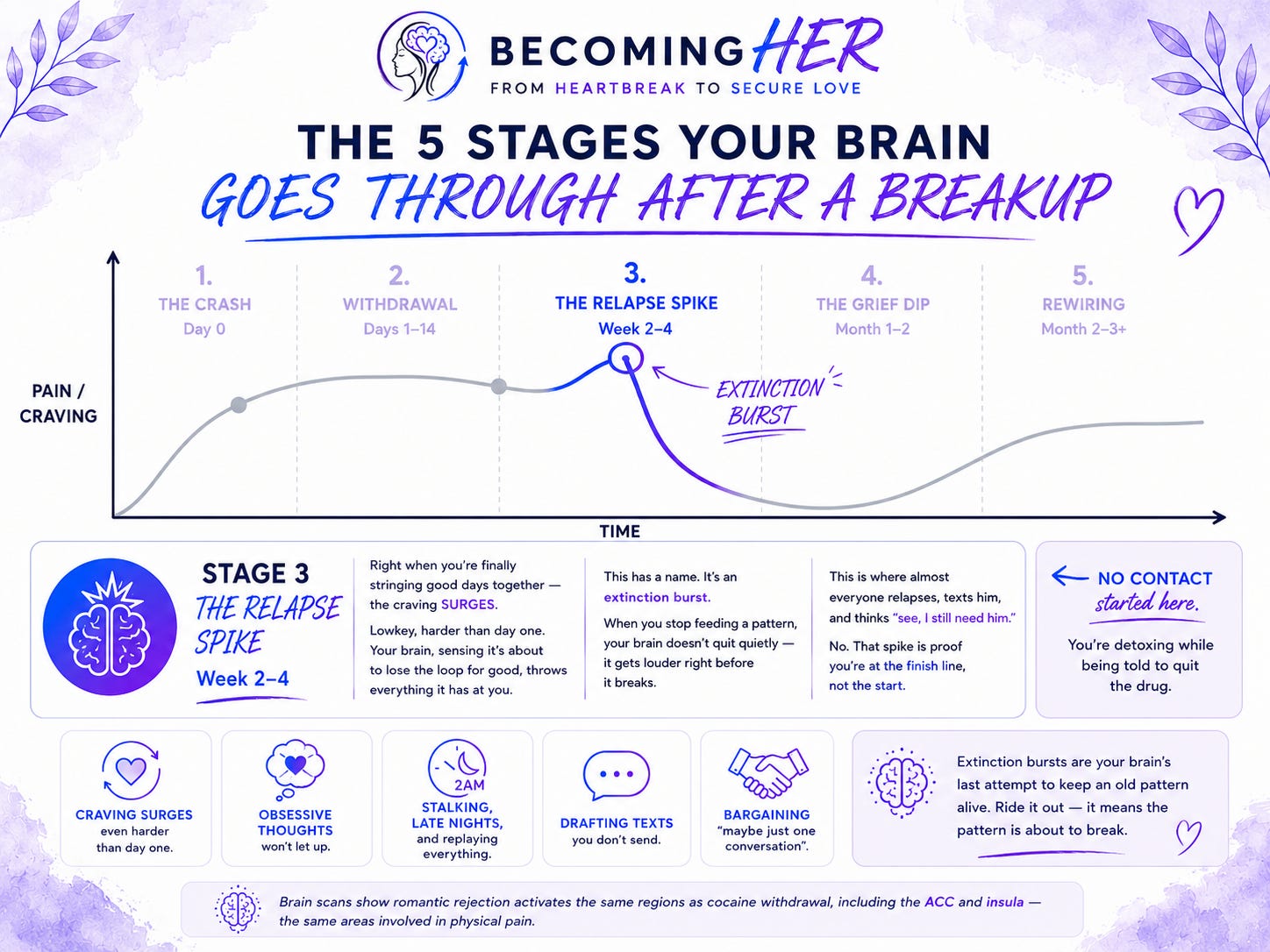
If you take one thing from this whole blog, take this stage.
It’s the trap.
What’s Happening in the Brain
You’re finally stringing decent days together. Two in a row. You catch yourself laughing at something. You think, oh thank God, I’m through the worst of it.
And then… It hits harder than day one.
In behavioral terms, this pattern is called an extinction burst.
When a behavior that used to reliably produce a reward stops producing it, the brain doesn’t quietly accept the update.
It escalates first, turns the volume all the way up to test whether the reward is really gone.
Same reason you press an elevator button eight more times when it doesn’t light up.
These types of extinction bursts are best documented in learning and behavioral research, not specifically in breakup studies, to be clear.
But the mechanism maps cleanly onto what happens here, and every clinician who works with heartbreak watches it play out on roughly this schedule.
Meanwhile, your prefrontal cortex, the part holding all the reasons this ended, loses influence right when arousal spikes.
You didn’t forget why you’re here.
You just lost access to it at 2am.
What It Looks & Feels Like
A wave of certainty that you’ve made a terrible mistake. Vivid recall of only the good. A fully-formed plan for what you’ll say. Skin crawling.
That specific voice going: it’s different now, I’m calmer now, one message wouldn’t hurt anything.

And that’s the con. The spike gets misread as evidence, proof you’ll never heal, proof he was the one, proof the last three weeks were fake.
It’s the opposite. The surge only happens because the loop is being broken.
No breaking, no burst.
That spike isn’t proof you’re at the start. It’s proof you’re at the finish line.
DO NOT confuse it.
Mini-Protocol: Stage 3
1. Name the stage out loud. Literally say: “This is the relapse spike. This is stage three. My brain is surging because it’s about to break the loop.” Putting an emotional state into words reduces amygdala activity and brings regulatory regions back online.
2. Pre-commit while you’re regulated. Decide today, at 2pm with a clear head, exactly what 2am-you does: text this specific friend, walk around the block, open this specific note. Future-you in a spike will not generate a good plan. She’ll just run whichever one is already loaded.
3. Delay, don’t debate. Don’t argue with the urge about whether he was good for you; you’ll lose, trust me, because your memory has stacked the deck. Just move the timeline: “If I still want to send this in 48 hours, I’ll send it.” Almost nobody still does. The spike has a half-life.
Stage three is the single most common place people quit, usually alone, at 2am, with nobody awake to talk them off it.
That’s the exact hour the Becoming HER Community exists for. There’s always someone in there who was on this spike last week, plus Becoming HER AI never sleeps, which members get access to.
Stage 4: The Grief Dip, Months 1–2
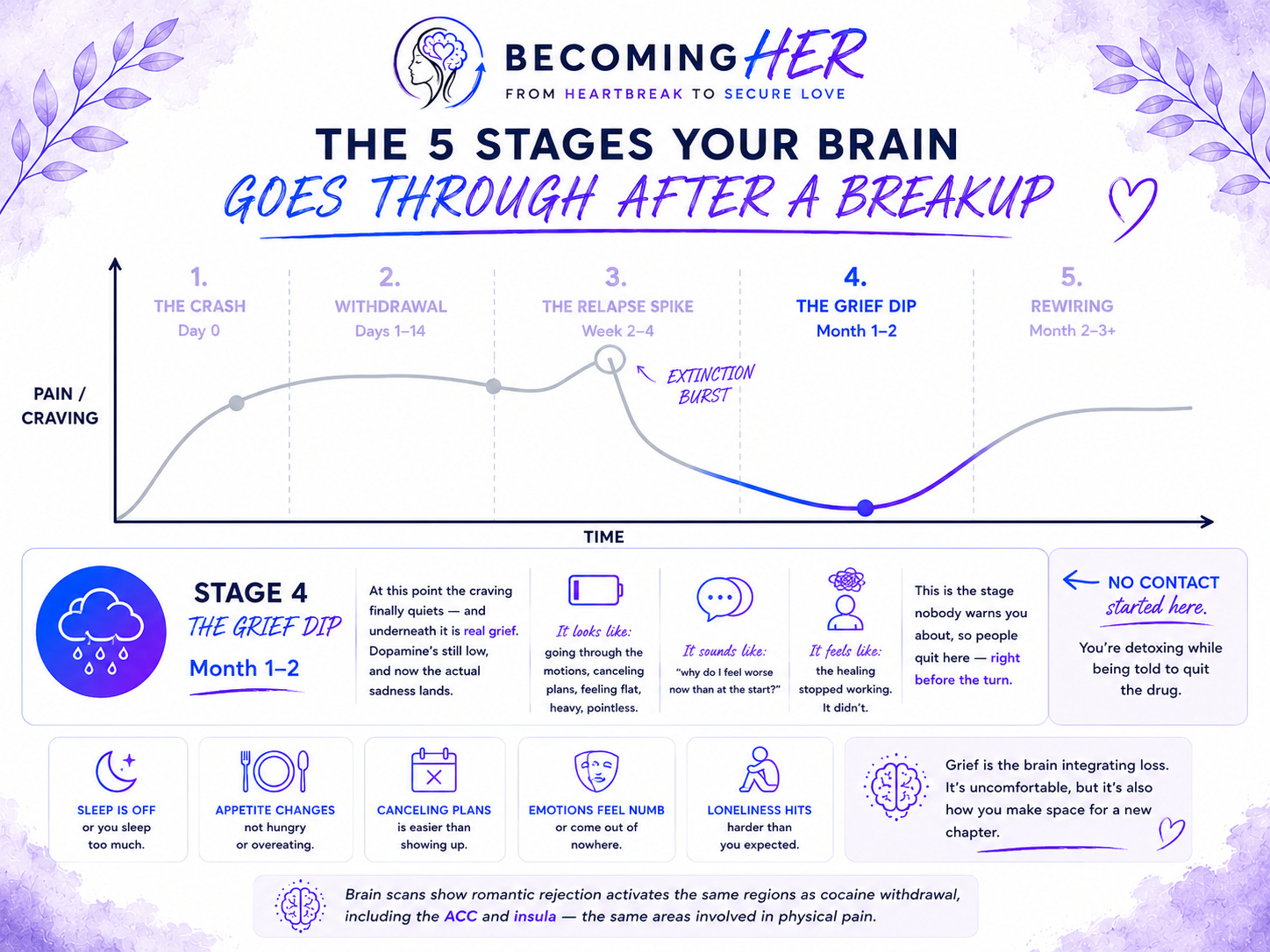
This is the one that blindsides people. Ask me how I know.
Thank God for my therapist. (S/O Kaitlyn)
What’s Happening in the Brain
The craving finally quiets down. And what’s underneath it isn’t a relief.
It’s grief.
Here’s the mechanism, and it’s a little brutal: craving is a high-arousal state.
It’s loud, it’s activating, and it keeps you connected to him. Obsessing is still a form of contact.
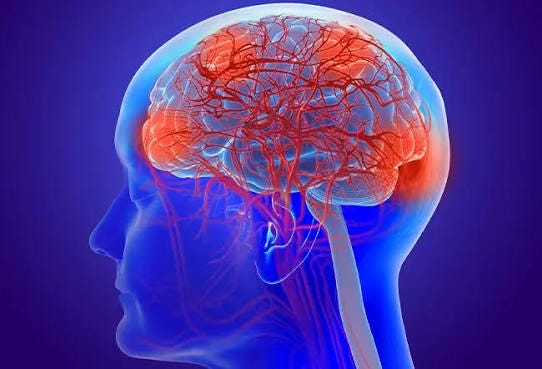
When the obsession fades, the connection actually ends, and now you’re mourning not just a person but a future, an identity, a version of yourself that only existed inside that relationship.
Chemically, your dopamine baseline is still low.
Not spiking-low. Flat-low. Tonic dopamine is your steady-burn motivation fuel, the thing that makes ordinary stuff feel worth doing, and it hasn’t been restored yet.
What It Looks & Feels Like
Going through the motions. Canceling plans you actually wanted to make.
Heavy limbs. Crying at a commercial. A flatness that’s almost worse than the pain, because at least the pain had energy in it.
It sounds like: “Why do I feel worse now than I did at the beginning? I think the healing stopped working.”
It didn’t stop working. This IS the working.
You’ve moved from withdrawal into mourning, and mourning is slower, quieter, and far less Instagrammable.
This is also the stage that lies about time.
I remember sitting there realizing it had been almost six months to the day, and being genuinely stunned, because it felt like two.
Grief runs on its own clock, and that clock is not the calendar’s.
And this is another common place people quit, right before the turn.
They decide the work failed and go find a new supply line, a rebound, an app binge, an ex who’s easy to reactivate.
Which resets the entire curve back to stage one with extra steps.
Mini-Protocol: Stage 4
1. Micro-dose behavioral activation. Don’t wait to feel motivated; motivation is downstream of the dopamine you don’t have yet. Action first, feeling second. One walk. One gym session. One coffee with one friend. These are small reps, they’re boring, they’re unsexy, and they’re how a flat baseline climbs.
2. Schedule a processing window. Twenty minutes, timer on, same time each day, where you let it be as bad as it is. Cry, write, feel all of it. Then the timer goes off, and you go live your day. You’re not regulating the grief away, and you’re not drowning in it 24/7. You’re giving it a container. Grief with a scheduled home stops ambushing you at work.
Stage 5: Rewiring — Months 2–3+
What’s Happening in the Brain
Neuroplasticity finally gets to do its job.
Your dopamine baseline restores. The anti-reward signal settles.
The cue-to-craving links weaken from repeated non-reinforcement; his name comes up, and there’s just… less.
Your prefrontal cortex gets its influence back, which means the reasons you always knew are now available to you when you’re activated, not only when you’re calm.
One day, you realize you went an entire afternoon without the ache. You won’t notice it at the moment.
You’ll notice it that night, and it’ll feel strange, and a little sad, and mostly like air.
This is something called extinction learning in neuroscience, not erasure.
The old pathway doesn’t get deleted; it gets outcompeted by newer, stronger ones.
Which is why a song can still catch you in the ribs eight months out.
That’s not relapse. That’s an old road that still exists on the map and hasn’t been driven in a long time.
What It Looks & Feels Like
Clarity returns. You can hold both truths at once, that it was real, and that it wasn’t working.
You stop needing the story to have a villain.
You get curious about your own part in it without that curiosity turning into self-blame.
It sounds like: “Huh. I haven’t thought about that in a week.”
You come back.
Mini-Protocol: Stage 5
1. Reconsolidate, don’t just avoid. There’s a window where an old emotional memory becomes temporarily editable, but you have to actually activate it and then have a genuinely different experience alongside it. In IFS terms: bring your adult Self to the part of you that was there when it happened, and let that part receive the protection it didn’t have the first time. The memory of the night I got broken up with changed for me when I did exactly this. Same events. Completely different meaning stored underneath them.
2. Give the new baseline something to be about. Restored dopamine needs a direction or it goes looking for the old supply line. Not a rebound, a direction. A goal, a training block, a project, a version of you that this whole thing made possible. You’re not going back to who you were before him. You’re building the next one. That’s exactly what we do inside my Becoming HER Program.
The Harder Truth
Two things, then I’ll get off my soapbox.
One: the curve isn’t a straight line. You’ll bounce. You’ll be in stage five and get dropped into stage three by a photo you didn’t expect. That’s not starting over — you keep everything you rewired, and the loops get shorter each time. But if you’re expecting a clean staircase, every dip will feel like failure. It isn’t.
Two — and this is the one nobody says out loud: time doesn’t heal this. Time plus the right inputs heals this. Time alone just relocates the pain somewhere quieter, where it waits to be repackaged as the thing you do in your next relationship. I know women who are five years “over it” and still choosing men who confirm the exact same story about themselves.
The stages will happen to you whether or not you participate. What you do inside each one determines whether you come out of this rewired — or just further away from it.
Knowing The Map And Walking It Are Two Different Things
Reading this at 11am with coffee is one thing.
Being on the curve at 2am, not knowing whether today is stage three or stage four, is where people drown.
Not because they don’t understand it, but because in the moment, understanding is offline and there’s nobody there to tell them what to do next.
So I built the thing I wish I’d had when I was on this curve myself.
Inside the Becoming HER Community, there’s a 63-day protocol called She Rises that drips to you one day at a time, mapped directly onto these five stages.

Every morning you open it, and I tell you exactly what to do that day.
No guessing which stage you’re in. No white-knuckling it alone. No thinking required on the days when thinking isn’t available.
Just the next right step, for 63 days straight, until you’re out of the rut and back to yourself.
Plus the women in there are on the same curve you are, which matters more than I can fit in a paragraph, given everything I just told you about co-regulation.
You don’t have to walk this stage alone.
One Last Thing
Five stages. Every one of them neurological, chemical, and predictable.
Not a single one of them a personal failing.
The nights you couldn’t stop crying, the text you sent and hated yourself for, the flatness in month two, the way a song still gets you, none of that is evidence that something’s wrong with you.
It’s evidence that you bonded deeply with another human being and your brain took it seriously.
It took it seriously because you’re capable of the real thing.
And that capacity doesn’t get destroyed when someone leaves.
It just needs somewhere better to land.
And that place DOES exist, I promise.
You’ve got this.
And as always… Live Heroically 🧠
Ready to Go Beyond Reading?
Reading helps you understand yourself. Transformation comes from applying it.
If you’re ready to move beyond consuming content and start creating lasting change, join me inside my Becoming HER Community.
Inside, I will help you go from heartbreak to secure love in 63 days.
You’ll Have Access To:
A neuroscience-based breakup recovery system
Weekly live coaching with me
Accountability to help you actually implement what you’re learning
A community of women healing and growing together
If you’re ready to become emotionally available, develop secure attachment, and attract healthy potential partners, this is for you!
Supporting Research
Fisher, H. E., Brown, L. L., Aron, A., Strong, G., & Mashek, D. (2010). Reward, addiction, and emotion regulation systems associated with rejection in love. Journal of Neurophysiology, 104(1), 51–60.
Volkow, N. D., & Baler, R. D. (2014). Addiction science: Uncovering neurobiological complexity. Neuropharmacology, 76, 235–249.
Koob, G. F., & Le Moal, M. (2008). Addiction and the brain antireward system. Annual Review of Psychology, 59, 29–53.
Kross, E., Berman, M. G., Mischel, W., Smith, E. E., & Wager, T. D. (2011). Social rejection shares somatosensory representations with physical pain. PNAS, 108(15), 6270–6275.
Eisenberger, N. I. (2012). The pain of social disconnection: Examining the shared neural underpinnings of physical and social pain. Nature Reviews Neuroscience, 13(6), 421–434.
Everitt, B. J., & Robbins, T. W. (2005). Neural systems of reinforcement for drug addiction: From actions to habits to compulsion. Nature Neuroscience, 8(11), 1481–1489.
Lerman, D. C., & Iwata, B. A. (1995). Prevalence of the extinction burst and its attenuation during treatment. Journal of Applied Behavior Analysis, 28(1), 93–94.
Bouton, M. E. (2004). Context and behavioral processes in extinction. Learning & Memory, 11(5), 485–494.
Ecker, B., Ticic, R., & Hulley, L. (2012). Unlocking the Emotional Brain: Eliminating Symptoms at Their Roots Using Memory Reconsolidation. Routledge.
Lieberman, M. D., Eisenberger, N. I., Crockett, M. J., Tom, S. M., Pfeifer, J. H., & Way, B. M. (2007). Putting feelings into words: Affect labeling disrupts amygdala activity in response to affective stimuli. Psychological Science, 18(5), 421–428.
Torre, J. B., & Lieberman, M. D. (2018). Putting feelings into words: Affect labeling as implicit emotion regulation. Emotion Review, 10(2), 116–124.
Sbarra, D. A., & Hazan, C. (2008). Coregulation, dysregulation, self-regulation: An integrative analysis and empirical agenda for understanding adult attachment, separation, loss, and recovery. Personality and Social Psychology Review, 12(2), 141–167.
Field, T. (2011). Romantic breakups, heartbreak and bereavement. Psychology, 2(4), 382–387.
This article is educational in nature and not a substitute for therapy. If attachment wounds or relational trauma are impacting your well-being, working with a trauma therapist can help your nervous system relearn safety in connection.
Thank you for such a well organized and efficient article -- Kudos!!