

TL;DR Summary:
Your head and your heart are not in conflict. They came to an agreement a while ago. One of them is just better at writing the press release.
There is no organ in your chest with an opinion about him. There ARE nerve cells in there, and they do something real, but it isn’t voting.
Four places this shows up... including one that happens out loud, at brunch, in a version of the story even you don’t fully believe while you’re telling it.
Why understanding him this well is the most expensive thing you’re currently doing. I’m calling it insight debt.
A two-minute test called The Decision Line that tells you whether a belief has actually updated, or whether you’ve just gotten really good at reciting it.
I Ran a Poll on Instagram Last Week
One woman typed back a sentence I haven’t been able to get outta my head since:
“My head and my heart aren’t in alignment.”
Then, she added: “I know what I deserve, but I still struggle to accept reality over potential.”
Whoever you are, thank you. You described the most common form of stuckness I see in my work, and you did it in fewer words than most textbooks manage.
You also got it exactly backwards.
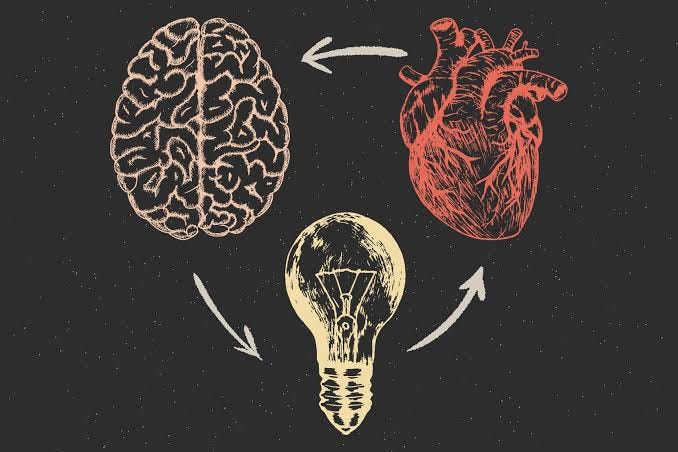
Your head and your heart aren’t out of alignment. They’re in agreement. They’ve BEEN in agreement.
They took a vote weeks ago, maybe months ago, and they both landed on the same answer: stay a little longer.
The only difference between them is job description. One of them feels the pull. The other one writes the justification.
Which leads to the belief that self-awareness is the first step toward change.
False.
For the women I work with, it’s actually often the most sophisticated way to avoid it.
I’ve been doing this since 2020, north of seventeen hundred sessions, and this pattern is extremely consistent.
The women who take the longest to leave are almost never the confused ones.
They’re the ones who can explain the relationship best. They know his attachment style, his mother’s attachment style, and the specific week in his childhood where it all went sideways.
Nobody has ever booked a call with me and said: “I’m using my intelligence to avoid making a decision.”
They say “I’m still processing it.”
Today, we’re gonna break this pattern :)
Let’s dive in!
You’re Not Confused. You’re Fluent.
Lemme try and describe your Tuesday night, and you tell me how close I get.
You’ve read the books. Probably Levine. Probably Van der Kolk, at least the parts everyone quotes. You know your style, and you know his. You can name the exact mechanism: he deactivates under intimacy, you hyperactivate under distance, and the two of you built a machine out of it.
You have a therapist. A good one. You have language for all of this that most people don’t get until their forties.

Now it’s 9:40pm, and you’re looking at your phone.
Not because you don’t understand. You understand beautifully. You could give a TED talk on this relationship, with slides, and half the audience would cry.
How’d I do?
You’re very clearly not lacking information.
You have never, at any point, been lacking information.
Which means information was never the variable.
The Head & the Heart
Let’s clear up the anatomy first, because the metaphor we’re using is doing damage.
There’s no organ in your chest with an opinion about him.
Now, before somebody @’s me: yes, the heart has its own cluster of nerve cells.
Cardiologists sometimes call it the “little brain” of the heart. It’s real.
And it regulates heart rate and contraction…
It, however, does NOT have thoughts about whether he texted back, and it has never once been consulted about your relationship. (I know. Disappointing. I wanted it to be cooler too.)

What you’re calling your “heart” is a felt signal. Your body shifts, your chest tightens or floods, and a region called the insula reads that shift and hands you a feeling with a story attached.
That’s interoception. It feels like wisdom arriving from somewhere deeper than thought, which is exactly why it’s so persuasive.
But the actual split you’re describing isn’t between two organs. It’s between two ways your brain learns.
System one learns from information. It’s the one that reads the books. It handles facts you can state out loud, it updates fast, and it’s the reason you can explain avoidant attachment at a dinner party.
System two learns from experience. It’s older, faster, and mostly non-verbal. It’s built around emotional learning that happened long before you had the vocabulary to describe it. It doesn’t store facts. It stores predictions: what happens when I need someone, what happens right before people leave, what I have to do to keep somebody close.
And, unfortunately for those of us on a healing journey, reading only updates the first system.
It leaves the second one completely untouched.
You cannot read your way out of a prediction.
The emotional learning system tends to update through experience that contradicts the prediction while the prediction is actually live and activated.

Not through argument. Not through insight. Not through a really good Instagram carousel (mine included 🙃).
This is roughly what the memory reconsolidation literature has been circling for two decades.
Emotional learning appears to become editable when it’s reactivated, and what edits it is a mismatch: the old prediction running, and then something happening that the prediction can’t account for.
But your understanding of him has never once been a mismatch. It’s commentary.
So the gap grows. Knowledge on one side, prediction on the other, and nothing crossing between them.
That gap has a cost.
I call it insight debt: understanding that keeps accumulating while nothing gets paid down on it.
Every book, every podcast, every 2am realization goes onto the pile.
The pile grows. Your life doesn’t move.
And because the pile FEELS like progress (it’s heavy, it took effort, it cost you something), you keep mistaking accumulation for movement.
Insight is only worth what you spend.
There are 4 places I see this happening the most often; let’s break ‘em down.
Split #1: You’ve Become His Biographer
You can explain him better than he can explain himself.
His mother. His last relationship, and what she did to him. Why he goes quiet on Sundays.
Why he pulled back right after the best weekend you’d had in months.
You’re not wrong about any of it. That’s what makes this the hardest one to catch.
But notice what the explanation is FOR.

Every time you explain his behavior, the behavior stops requiring a response from you. An explained thing feels handled.
Your body relaxes half a notch, the alarm quiets, and you get to stay exactly where you are for another week.
That relief is the payoff, and it’s why this repeats.
Behavior that reliably produces relief gets repeated, whether or not it produces change. Your brain isn’t tracking “did this improve my life.” It’s tracking “did this make the discomfort stop.”
Understanding him makes the discomfort stop.
Nobody calls this avoidance, by the way.
They call it “being understanding.” They call it “having compassion for where he’s at.” And the compassion is real…
It’s just pointed in exactly the direction that requires nothing from you.
Lemme put myself in this one, since I’ve done it.
When my last relationship ended (abruptly, in a way I did not see coming), I texted her about a month later and asked if she’d get on a call to talk it through. I told myself I needed to understand what happened. That was the word I used.
She said no.
I was angry about that for a long time. I had built my entire recovery plan around getting an explanation from the one person on earth with no incentive to give me an accurate one.
Here’s what I know now, 2 years and a lot of therapy later.

If she’d said yes, I’d have gotten a story. And I’d have spent the next six months analyzing that story. And I’d have called those six months healing.
Getting told no is what actually started the clock.
Not because it was kind. Because it closed the research department.
How to See It Early
Pull up your Notes app and start to track how you talk about him for a week. In conversations with friends & family, to yourself, etc.
At the end of the week, count how many end with an explanation of his behavior versus how many end with something you’re going to DO.
If it’s five to zero, you’re not processing.
You’re writing his biography, and he isn’t paying you for it.
Split #2: The Leave Date That Keeps Moving
You already decided.
You decided a while ago. What you’re doing now is scheduling.
After the holidays. After his work thing settles down. After the trip you already paid for. When you feel stronger. When you’ve saved a bit more. After his sister’s wedding, because leaving before his sister’s wedding would be cruel, and you’re not cruel.
I’ve heard it all, and each one is reasonable. That’s the point...
Because a decision with a start date delivers almost the entire emotional payload of the decision itself.

You get the relief of having chosen. You get to feel like a woman with a plan.
AND you pay none of the cost, because the cost lives in the future, where a slightly stronger version of you is apparently waiting to handle it.
Avoidance is not passive. It’s actively rewarded.
Every time the deadline moves, your nervous system gets an immediate hit of relief, and immediate relief is one of the most reliable teachers your brain has.
The delay gets reinforced. Then it gets easier. Then it gets automatic.
So the date moves again.
Nobody says “I’m avoiding this.” They say “I’m waiting until I’m stronger.”
A deadline you’ve moved twice isn’t a plan.
It’s a sedative you’re prescribing yourself, dude.
How to See It Early
Write down the current date you’re waiting for.
Then write down the last two.
If the list has three entries, the number is not the problem, and the fourth one won’t be either… :)
Split #3: The Brunch Version
There are two versions of your relationship, and you’re the author of both.
There’s the one you’d write down at 2am, alone, in your Notes app, with no audience and no one to protect. And there’s the one you tell at brunch.
The brunch version has softer edges. Better context. A laugh in the middle. It opens with “so this is actually kind of funny” and it ends with “but honestly it’s been better lately.”
You’re not lying to your friends.

You’re doing something more ordinary and much more expensive. You’re rehearsing.
Telling a story changes the story. Not metaphorically, literally.
Retelling is its own act of encoding, and the version you tell out loud tends to become more available to you than the version you actually lived.
People shape stories to their audience, and then remember their own shaped version. Every retelling is a rep.
So the brunch version gets smoother. Easier to say. Easier to believe.
And after enough reps, it isn’t the version you tell anymore; it’s the version you live in.
Notice the logic there. You’re protecting his reputation with the only people positioned to tell you the truth.
How to See It Early
Tonight, write the 2am version. No audience, no fairness, no context, no “to be fair.”
Just the facts of the last two months as they’d read to a stranger.
Then read it and notice which paragraphs you’d never say out loud.
Those paragraphs are the actual relationship.
Split #4: You’re Not Confused. You’re Invested.
Let’s go back to our original sentence for this one: “I still struggle to accept reality over potential.”
You already know capacity versus potential. I’ve written about it, you’ve read it, and you could explain it to a friend tomorrow without notes.
Who he could be under ideal conditions versus who he’s consistently able to be. Who he is on average, not at his best.
So I’m not going to re-teach it. You’re not confused about the concept.
You’re invested in the outcome…

And those are completely different problems with completely different exits.
Confusion is solved by information. You’re past that.
Investment is a different animal: the more you’ve put into something, the harder it becomes to walk away from it, and the more your mind works to justify what you’ve already spent.
That’s not a character flaw. It’s one of the most replicated findings in decision research, and it operates on your commitments too, not just your money.
Here’s what makes YOUR version expensive.
The thing you’ve invested isn’t years, and it isn’t sex, and it isn’t the apartment.
It’s Split #1. It’s all that interpretive labor.
Every hour spent understanding him, every framework you applied, every 2am reconstruction of why he is the way he is.
You didn’t just love him. You built a comprehensive theory of him, and the theory has a conclusion baked in: he could get there.
Leaving would mean the theory was expensive and useless. All that understanding, purchased at full price, redeemable nowhere.
That’s the real sunk cost. Not the years. The understanding.
Which is also why the smartest women stay longest. You’ve invested more, because you had more to invest.
Nobody has ever told me “I’m attached to his potential.”
They say “I’ve seen who he really is.”
And I always ask the same question back: seen him, or seen him ONCE?
Because potential is a memory of a good weekend, running as a forecast.
Your brain leans optimistic about outcomes it’s committed to.
It’s not lying to you. It’s protecting the investment.
How to See It Early
List every moment from the last ninety days that you’d use as evidence of who he really is. Dates included.
Ninety days is roughly thirteen weekends. If your list has three items, you don’t have a pattern. You have three good days and a very well-built theory.
(And if the list is long and specific and recent... that’s real information too. This test isn’t rigged. It just requires you to actually run it.)
The Part of You Doing All This
So who’s running the analysis?
In IFS terms, this is a protective Part usually, and it’s one I see constantly in high-achieving women. I call her The Case Builder.
She sits right next to The Fixer and The Strong One in the lineup, and she’s the sharpest of the three by a mile.
Her whole job is to understand the situation before it can hurt you. And she’s good at it, because she got a LOT of practice.
Somewhere back there, in a house where an adult’s mood could turn without warning, understanding people wasn’t an intellectual hobby. It was surveillance.

It was how you knew whether tonight was gonna be fine.
If you could predict them, you could prepare for them. If you could explain them, they were less frightening.
She built that skill for you. She kept you safe with it.
And then you grew up and got a degree and a career and a therapist, and she’s still running the same protocol, just with better vocabulary.
Same girl at the top of the stairs listening for the tone of the front door. She just says “deactivating attachment strategy” now instead of “he’s in a mood.”
Here’s the limitation though...
She can only see one move ahead of the pain.
She’s not solving for your future. She’s solving for don’t feel it yet. And she’s convinced you that’s the same as solving for figure it out.
So no, don’t fight her. Fighting a protector just makes her work harder, and she has more stamina than you do (she’s been at this since you were seven).
You just need to notice when she’s driving. And then give her a job she can actually win at.
Speaking of which… Let’s get practical!
The Decision Line: A 3-Step Tool for When You Catch Yourself Explaining
This takes about two minutes. It’s not a breakthrough exercise, and it will not make you cry.
It’s a rep, and reps are how the second system learns anything.
Step 1: Catch the “because”
The tell is the word because.
Whenever you catch yourself building a case, out loud or in your head, that’s the moment. Not tonight, not in your journal later. Right then, mid-sentence.
“He’s been distant because work has been insane.”
“I didn’t bring it up because he’d already had a hard day.”
“I’m waiting because I want to be sure.”
You’re not catching a lie. All three of those might be true.

You’re catching The Case Builder clocking in, and the reason you have to catch it live is that she’s fast.
Give her ninety seconds, and she’ll have built something airtight, and you’ll be agreeing with it.
Step 2: Run the line
One question. Ask it exactly like this: “Does that sentence end in an explanation, or a decision?”
Explanations end in because. Decisions end in a verb you have to actually do something about.
“He’s distant because work is insane” is an explanation.
“I’m going to tell him tonight that I need one real conversation this week” is a decision.
Both can be true at once. Only one changes your Thursday.
Insight debt is every sentence that ended in “because.”
Spending it is turning one of them into a verb.
And a hard rule, since I know how good you are at this: an explanation followed by a decision-shaped feeling doesn’t count.
“I really need to talk to him about this” is not a decision. It’s an explanation wearing a costume. (I see you.)
Step 3: Answer in your body before your mind gets there
You’ve got maybe ten seconds before your Case Builder supplies a better answer. Use them.
Say the decision-shaped version of the sentence out loud.
Then, immediately, before any analysis: where did that land in your body, and what happened there?
Not what do I think about that. Where did it go, and what did it do.

Chest tightened. Stomach dropped. Something opened up behind the ribs. Throat closed. Nothing at all (that’s data too).
Then name it in one word.
Naming a feeling in plain language is doing something, not just describing something.
Putting an emotional state into words is associated with a measurably different response than sitting inside it wordlessly.
It’s small, but it’s also one of the few moves that reaches the system that actually runs your life.
This is the whole reason the step exists.
You’ve been trying to reach that system through reading. Reading was never gonna get there.
You Don’t Need Another Insight
You came in thinking your feelings were behind your understanding.
That your heart was the slow one, dragging, refusing to catch up to what your head already figured out.
It’s the other way around.
The understanding was never ahead. It was the delay.
Your heart didn’t fail to get the memo. Your heart was never the one that needed convincing, because it’s not the part of you that learns from memos.
It learns from what you actually do, on a Tuesday, when it costs something.
So you don’t need to understand him better. You’ve already understood him more thoroughly than anyone else ever will, including him, and it bought you nothing but a very detailed map of a place you’re still standing in.
You need to spend one thing you already know.
One sentence, turned into a verb, this week.
Understanding him was never the assignment. Deciding was.
You’ve got this.
And as always, until next time… Live Heroically 🧠
Ready to Go Beyond Reading?
Reading helps you understand yourself. Transformation comes from applying it.
If you’re ready to move beyond consuming content and start creating lasting change, join me inside my Becoming HER Community.
Inside, I will help you go from heartbreak to secure love in 63 days.
You’ll Have Access To:
A neuroscience-based breakup recovery system
Weekly live coaching with me
Accountability to help you actually implement what you’re learning
A community of women healing and growing together
If you’re ready to become emotionally available, develop secure attachment, and attract healthy potential partners, this is for you!
Supporting Research
LeDoux, J. E. (2000). Emotional circuits in the brain. Annual Review of Neuroscience, 23, 155–184.
Phelps, E. A. (2004). Human emotion and memory: Interactions of the amygdala and hippocampal complex. Current Opinion in Neurobiology, 14(2), 198–202.
Squire, L. R. (2004). Memory systems of the brain: A brief history and current perspective. Neurobiology of Learning and Memory, 82(3), 171–177.
Ecker, B., Ticic, R., & Hulley, L. (2012). Unlocking the Emotional Brain: Eliminating Symptoms at Their Roots Using Memory Reconsolidation. Routledge.
Lane, R. D., Ryan, L., Nadel, L., & Greenberg, L. (2015). Memory reconsolidation, emotional arousal, and the process of change in psychotherapy. Behavioral and Brain Sciences, 38, e1.
Nader, K., Schafe, G. E., & LeDoux, J. E. (2000). Fear memories require protein synthesis in the amygdala for reconsolidation after retrieval. Nature, 406(6797), 722–726.
Schiller, D., Monfils, M. H., Raio, C. M., Johnson, D. C., LeDoux, J. E., & Phelps, E. A. (2010). Preventing the return of fear in humans using reconsolidation update mechanisms. Nature, 463(7277), 49–53.
Craig, A. D. (2002). How do you feel? Interoception: The sense of the physiological condition of the body. Nature Reviews Neuroscience, 3(8), 655–666.
Barrett, L. F., & Simmons, W. K. (2015). Interoceptive predictions in the brain. Nature Reviews Neuroscience, 16(7), 419–429.
Armour, J. A. (2008). Potential clinical relevance of the “little brain” on the mammalian heart. Experimental Physiology, 93(2), 165–176.
Dunn, B. D., Galton, H. C., Morgan, R., Evans, D., Oliver, C., Meyer, M., Cusack, R., Lawrence, A. D., & Dalgleish, T. (2010). Listening to your heart: How interoception shapes emotion experience and intuitive decision making. Psychological Science, 21(12), 1835–1844.
Kunda, Z. (1990). The case for motivated reasoning. Psychological Bulletin, 108(3), 480–498.
Bradbury, T. N., & Fincham, F. D. (1990). Attributions in marriage: Review and critique. Psychological Bulletin, 107(1), 3–33.
Nisbett, R. E., & Wilson, T. D. (1977). Telling more than we can know: Verbal reports on mental processes. Psychological Review, 84(3), 231–259.
Krypotos, A. M., Effting, M., Kindt, M., & Beckers, T. (2015). Avoidance learning: A review of theoretical models and recent developments. Frontiers in Behavioral Neuroscience, 9, 189.
Marsh, E. J. (2007). Retelling is not the same as recalling: Implications for memory. Current Directions in Psychological Science, 16(1), 16–20.
Echterhoff, G., Higgins, E. T., & Levine, J. M. (2009). Shared reality: Experiencing commonality with others’ inner states about the world. Perspectives on Psychological Science, 4(5), 496–521.
Pennebaker, J. W., & Beall, S. K. (1986). Confronting a traumatic event: Toward an understanding of inhibition and disease. Journal of Abnormal Psychology, 95(3), 274–281.
Rusbult, C. E. (1980). Commitment and satisfaction in romantic associations: A test of the investment model. Journal of Experimental Social Psychology, 16(2), 172–186.
Arkes, H. R., & Blumer, C. (1985). The psychology of sunk cost. Organizational Behavior and Human Decision Processes, 35(1), 124–140.
Sharot, T. (2011). The optimism bias. Current Biology, 21(23), R941–R945.
Lieberman, M. D., Eisenberger, N. I., Crockett, M. J., Tom, S. M., Pfeifer, J. H., & Way, B. M. (2007). Putting feelings into words: Affect labeling disrupts amygdala activity in response to affective stimuli. Psychological Science, 18(5), 421–428.
Torre, J. B., & Lieberman, M. D. (2018). Putting feelings into words: Affect labeling as implicit emotion regulation. Emotion Review, 10(2), 116–124.
Gollwitzer, P. M. (1999). Implementation intentions: Strong effects of simple plans. American Psychologist, 54(7), 493–503.
Gollwitzer, P. M., & Sheeran, P. (2006). Implementation intentions and goal achievement: A meta-analysis of effects and processes. Advances in Experimental Social Psychology, 38, 69–119.
Mikulincer, M., & Shaver, P. R. (2007). Attachment in Adulthood: Structure, Dynamics, and Change. Guilford Press.
Schwartz, R. C., & Sweezy, M. (2020). Internal Family Systems Therapy (2nd ed.). Guilford Press.
Schwartz, R. C. (2021). No Bad Parts: Healing Trauma and Restoring Wholeness with the Internal Family Systems Model. Sounds True.
Leave a Comment
Which of the four did you feel in your chest first? Tell me. I read them all.
This article is educational in nature and not a substitute for therapy. If attachment wounds or relational trauma are impacting your well-being, working with a trauma therapist can help your nervous system relearn safety in connection.
Hey Cody,
I'm coming at this from two different angles. 1. As someone who works in the mental health publishing world and 2. As one of the women you're writing this post for. You do an exceptional job taking what could easily dissolve into jargon and making it usable. Thanks for this. Your steps at the end were particularly helpful. Instead of rationalizing something that wasn't working for me I just asked for what I wanted.